

You take your curcumin supplement every morning, expecting relief from joint inflammation or a sharper mind. But here’s what most supplement labels won’t tell you: the majority of the curcumin in a standard capsule passes through your body largely unused. Absorption, not dosage, is the real factor that separates a supplement that works from one that doesn’t. This guide breaks down the science behind curcumin’s absorption challenge, reviews popular solutions, and gives you the practical tools to make every dose actually count.
Table of Contents
- Why curcumin is difficult for the body to absorb
- Popular absorption boosters: Black pepper and dietary fats
- Do advanced formulations actually deliver better absorption?
- Practical strategies to get the most from your curcumin
- Most people misunderstand “absorption” — here’s the reality
- Explore solutions for smarter absorption
- Frequently asked questions
Key Takeaways
| Point | Details |
|---|---|
| Absorption is the key challenge | Curcumin’s effectiveness depends on overcoming poor bioavailability and rapid metabolism. |
| Boosters aren’t created equal | Fats consistently improve absorption, while black pepper’s benefits may be overstated for active curcumin. |
| Advanced formulas require scrutiny | Micelles and nanoparticles can help, but look for free curcumin levels, not just total curcuminoids. |
| Read supplement labels carefully | Seek transparency about absorption claims—prefer products reporting free, unconjugated curcumin. |
Why curcumin is difficult for the body to absorb
Now that you know many supplements promise results, let’s see why curcumin is uniquely hard for your body to use. Curcumin is the primary active compound in turmeric, responsible for its golden color and most of its celebrated health properties. But getting curcumin from a capsule into your bloodstream in a usable form is genuinely difficult, and the reasons are rooted in basic chemistry and biology.
The core problem is solubility. Curcumin is lipophilic, meaning it dissolves in fat but not in water. Since your digestive tract is largely a water-based environment, curcumin particles tend to clump together and resist absorption through the intestinal wall. Think of it like trying to mix olive oil into a glass of water: no matter how much you stir, they just don’t combine well.
Beyond the solubility problem, your body actively works to break curcumin down before it can reach the bloodstream. Poor oral bioavailability results from rapid metabolism in the intestine and liver through processes called glucuronidation and sulfation (Phase II enzyme reactions). These processes attach sugar or sulfate molecules to curcumin, converting it into conjugated (inactive) forms that your kidneys then eliminate quickly.
Here’s a summary of the key absorption barriers:
- Low water solubility: Curcumin won’t dissolve in the watery digestive environment, limiting how much can cross the intestinal wall.
- Rapid Phase II metabolism: Enzymes in the intestine and liver quickly convert free curcumin into inactive conjugates.
- Fast systemic elimination: Even the small amount that enters the bloodstream is cleared rapidly, leaving little time for it to reach target tissues like joints or the brain.
- Poor lymphatic uptake: Without the right delivery vehicle, curcumin struggles to enter the lymphatic system, which is one of the main pathways for fat-soluble compounds.
“The result is that when you swallow a standard curcumin capsule, you may be absorbing only a tiny fraction of the curcuminoids (the family of active compounds in turmeric) in a form your body can actually use. It’s a bit like wanting a strong cup of coffee instead of just sniffing the beans.”
Understanding these barriers is not meant to discourage you. It’s meant to help you make smarter choices. Once you know why curcumin is hard to absorb, the solutions start to make a lot more sense.
Popular absorption boosters: Black pepper and dietary fats
Understanding why curcumin is hard to absorb, it’s time to review the popular ways people try to overcome the problem. Two strategies dominate the conversation: pairing curcumin with black pepper extract (piperine) and taking it alongside dietary fats. Both have real science behind them, but both also come with important nuances that most marketing materials conveniently leave out.
Black pepper (piperine): The 2000% claim unpacked
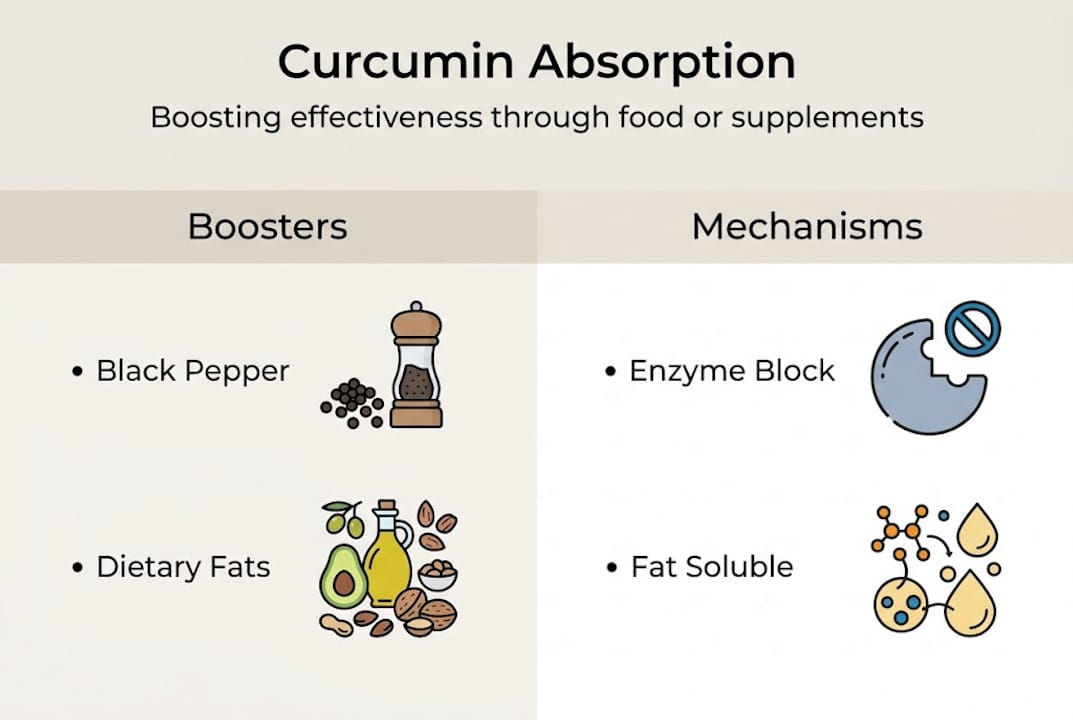
You’ve probably seen supplements boasting “enhanced with BioPerine” or “black pepper extract for 2000% better absorption.” That figure comes from a 1998 human study comparing 2g of curcumin plus 20mg of piperine against curcumin alone, which showed a dramatic increase in total curcumin levels in the blood. Piperine works by inhibiting the glucuronidation enzymes that would otherwise convert curcumin into inactive forms.

However, the story is more complicated. More recent independent studies show that while piperine increases total curcumin in the bloodstream, it does not significantly increase unconjugated (free/active) curcumin plasma levels. This distinction matters enormously. Free curcumin is the biologically active form most associated with anti-inflammatory and cognitive benefits. Conjugated curcumin, the form that piperine mainly boosts, is largely inactive. Using a formulation like BioSoluble® Curcumin™ is drastically more effective.
There’s also a practical concern: piperine inhibits certain liver enzymes (specifically CYP3A4 and CYP2D6) that process many common medications. If you take prescription drugs, check with a doctor before adding a piperine-containing supplement.
Dietary fats: A reliable ally
Because curcumin is fat-soluble (lipophilic), taking it alongside dietary fats is one of the most reliable and practical ways to improve absorption. Fats help curcumin form micelles (tiny fat-surrounded particles) in the digestive tract, which the intestinal wall can absorb far more efficiently. A 2015 study confirmed a substantial increase in curcumin uptake when taken with lipids.
Practical fat-pairing options include:
- Golden milk: Warm turmeric mixed with full-fat coconut milk or whole dairy milk, a small amount of black pepper, and a teaspoon of coconut oil or ghee.
- Curcumin with a meal: Take your supplement at the same time as a meal that contains healthy fats (avocado, olive oil, nuts, fatty fish).
- Oil-based dressings: If using turmeric powder in food, combine it with an oil-based dressing or sauce.
Pro Tip: Always take your curcumin supplement with a fat-containing meal rather than on an empty stomach. This single habit can meaningfully improve how much active curcumin reaches your bloodstream, regardless of which formulation you choose.
| Strategy | Mechanism | Impact on total curcumin | Impact on free (active) curcumin |
|---|---|---|---|
| Black pepper (piperine) | Inhibits Phase II metabolism | High (up to 2000%) | Low to minimal |
| Dietary fats | Micelle formation | Moderate to high | Moderate |
| Advanced formulations | Encapsulation/delivery tech | Very high | Variable (see next section) |
Do advanced formulations actually deliver better absorption?
With common boosters examined, how do cutting-edge technologies stack up in real absorption, and do they justify their price? The supplement industry has invested heavily in delivery technologies designed to solve curcumin’s bioavailability problem at a more fundamental level. These go by names like micelles, phytosomes, nanoparticles, and lipid complexes. Let’s look at what each actually does and what the data shows.
Defining the key technologies
- Micellar curcumin: Curcumin is encapsulated in tiny fat-water hybrid particles (micelles) that allow it to dissolve in the digestive tract and cross the intestinal wall more easily.
- Phytosomes: Curcumin is bound to phospholipids (the same type of fat found in cell membranes), which improves both absorption and cellular uptake.
- Nanoparticles: Curcumin is reduced to nanoscale particles, increasing its surface area and improving dissolution rate.
- Longvida and SLCP (Solid Lipid Curcumin Particle): Curcumin is embedded in a solid lipid matrix, designed specifically to increase free (unconjugated) curcumin delivery to the brain.
What the numbers actually say
Advanced formulations like micellar curcumin (for example, NovaSOL) can achieve up to 185x higher bioavailability relative to unformulated curcumin in comparative reviews. That sounds impressive. But a closer look at a 2025 pharmacokinetic study reveals that even NovaSOL only achieved peak unconjugated curcumin levels of up to 38 nM briefly, which is roughly 100 times below the concentrations shown to be effective in laboratory (in vitro) studies.
In a separate study, BioTurm (with ar-turmerone) achieved a peak total curcuminoid level of 648 ng/mL, which was superior to low-piperine formulations (11 ng/mL) and comparable to high-piperine versions (664 ng/mL). This suggests that certain novel formulations can compete with or exceed piperine-based approaches for total curcumin delivery.
Key statistic: Micellar curcumin formulations can deliver up to 185 times more curcumin into the bloodstream compared to standard unformulated curcumin, yet free curcumin levels in most studies still fall well below concentrations used in cell-based research.
How to evaluate supplement claims: A step-by-step approach
- Check what’s being measured. Does the label or study report total curcumin or free (unconjugated) curcumin? Total numbers are almost always higher and often include inactive conjugates.
- Look for the delivery technology name. Generic “enhanced bioavailability” claims without a named technology (micellar, phytosome, SLCP, etc.) are a red flag.
- Ask for human clinical data. Animal studies and in vitro (lab dish) results do not reliably predict what happens in a human body.
- Compare the dose used in studies. A formulation tested at 4g per day is not directly comparable to a product delivering 500mg.
- Prioritize transparency. Brands that openly share their absorption data, including free curcumin measurements, are far more trustworthy than those relying on vague marketing language.
Practical strategies to get the most from your curcumin
With a clear view of the absorption landscape, here’s how you can put these insights into action for real-world results. Whether you’re targeting joint inflammation, supporting a healthy immune response, or looking for cognitive benefits, these strategies apply across the board.
Building an effective daily routine
The goal is to maximize the amount of free, unconjugated curcumin that reaches your target tissues. Here’s how to approach that practically:
- Always take curcumin with fat. A meal containing avocado, olive oil, nuts, or full-fat dairy is ideal. This is the single most reliable dietary strategy for improving absorption.
- Choose formulations wisely. Look for products that name their delivery technology and report BioSoluble curcumin levels in their clinical data.
- Be consistent. Curcumin’s benefits for inflammation and cognitive support build over time. Sporadic use won’t give you the results that daily, well-absorbed doses can.
- Avoid taking curcumin on an empty stomach. Without fat present, absorption drops significantly, and you may also experience mild digestive discomfort.
Common mistakes to avoid
Many people invest in curcumin supplements but undermine their own results through a few avoidable errors. Prioritizing formulations that measure free curcumin rather than total curcumin is one of the most important steps you can take as a savvy consumer. Relying solely on a “black pepper included” label without understanding what it actually delivers is a common trap. Similarly, choosing the cheapest option without checking the delivery technology often means paying for curcumin your body will simply eliminate.
Pro Tip: When reading a supplement label, look specifically for phrases like “BioSoluble curcumin,” “unconjugated curcumin,” or a named technology such as “micellar,” “phytosome,” "BioSoluble® Curcumin™" or “SLCP.” These terms indicate the brand is thinking beyond basic bioavailability marketing and is focused on delivering the form of curcumin your body can actually use.
Matching your supplement to your goal
Different health goals may benefit from slightly different approaches:
- Inflammation relief (joints, muscles): Prioritize formulations with high total curcuminoid delivery combined with fat-based delivery systems. BodyControl from SuperNatural is formulated to support a healthy inflammatory response.
- Cognitive support: Free (unconjugated) or BioSoluble® Curcumin™ is especially important here, as it needs to cross the blood-brain barrier. Look for technologies specifically designed for brain delivery, such as SLCP or advanced micellar systems.
- Immune support: Consistent daily dosing with a well-absorbed formulation supports the kind of steady curcumin exposure that benefits immune function over time.
Most people misunderstand “absorption” — here’s the reality
We’ve spent years reviewing the evidence on curcumin, and the most consistent pattern we see is this: the supplement industry has trained consumers to equate “higher absorption” with “better results.” It’s an understandable shortcut, but it’s not accurate.
Here’s the uncomfortable truth. When a brand claims their formula delivers “20x more curcumin,” they almost always mean total curcumin, which includes the conjugated (inactive) forms that your body produces as part of normal metabolism. These conjugates circulate in the blood and show up in lab measurements, but they don’t deliver the same biological activity as BioSoluble® Curcumin™.
For inflammation relief and cognitive benefits, free curcumin is what matters most. It’s the form that interacts with inflammatory pathways (like NF-kB signaling) and that can potentially cross the blood-brain barrier to support neurological health. Prioritizing formulations that measure free curcumin is not just a preference; it’s the scientifically sound approach.
We believe that transparency is the foundation of a trustworthy supplement. That’s why we built BioSoluble® Curcumin™ around a patented process specifically designed to enhance the delivery of bioavailable curcumin, not just inflate total absorption numbers. When you’re shopping for a curcumin supplement, ask the hard questions: What form of curcumin is being measured? Is there human clinical data? Does the brand explain its delivery technology clearly? A brand that can answer those questions confidently is one worth your trust.
The bottom line: absorption numbers are a starting point, not a finish line. What matters is whether the curcumin you’re taking is reaching your tissues in a form it can actually use.
Explore solutions for smarter absorption
Having separated fact from hype in absorption, here are some thoughtful next steps for maximizing curcumin’s potential.
If the science in this article has made one thing clear, it’s that not all curcumin supplements are created equal. Choosing a product built around real bioavailability, specifically one that prioritizes free curcumin delivery, is the most important decision you can make as a supplement consumer.
At SuperNatural, we put years of research into developing our BioSoluble® Curcumin™ technology, a patented process that goes beyond standard bioavailability enhancements to deliver curcumin in a genuinely usable form. For those focused on cognitive health, our BrainBoost cognitive support formula is specifically designed for advanced brain support using this same absorption-forward approach. Explore our range and find the solution that fits your health goals.
Frequently asked questions
How long does it take to feel the effects of curcumin?
Most users report noticeable effects within 4 to 8 weeks of consistent daily use, though results depend heavily on the quality of absorption and the amount of active curcumin actually reaching target tissues.
Is black pepper necessary for curcumin supplements to work?
Black pepper can increase total curcumin blood levels, but recent studies show it may not meaningfully boost the free (active) form most responsible for inflammation and cognitive benefits, so it is not an effective absorption strategy.
Can I boost curcumin absorption with food?
Yes, taking curcumin alongside dietary fats significantly improves absorption because curcumin is fat-soluble, and fats help form micelles that allow the intestinal wall to take up curcumin far more efficiently.
Are advanced curcumin formulations worth the cost?
Some advanced formulations do meaningfully increase active curcumin absorption, but total absorption numbers can be misleading since they often include inactive conjugates. Look for products that specifically report free (unconjugated) curcumin levels and name their delivery technology clearly.
Recommended
- BioSoluble® Curcumin™ – SuperNatural
- SuperNatural Supplements | BioSoluble® Curcumin™
- BodyBoost: Ultimate Immune Support – SuperNatural
- SuperNatural BrainBoost
This article is provided for educational and informational purposes only and does not constitute providing medical advice or professional services. Always consult with a qualified and licensed physician or other medical care provider. Statements have not been evaluated by the Food & Drug Administration. This product is not intended to diagnose, treat, cure, or prevent any disease.