

The habits you practice today are quietly shaping your brain’s future. Poor sleep alone can double your dementia risk, yet most people treat sleep as optional. The good news is that the same research revealing these risks also shows that consistent, evidence-backed lifestyle changes can meaningfully protect your cognitive function for decades. This guide cuts through the noise and gives you a practical, science-grounded roadmap for building brain health habits that actually stick, starting right now.
Table of Contents
- What you need to start supporting brain health
- Step-by-step: Building your daily brain health routine
- Are brain supplements worth it? What science really says
- Common mistakes and how to avoid them
- What to expect: Signs your brain health routine is working
- Why “all-in-one” brain hacks don’t work: consistency and multidomain lifestyle do
- Take your brain health to the next level with SuperNatural
- Frequently asked questions
Key Takeaways
| Point | Details |
|---|---|
| Consistent routines matter most | Combining exercise, diet, sleep, and engagement protects your brain best. |
| Supplements are secondary | Dietary and lifestyle changes offer stronger evidence for brain benefits than most pills. |
| Social and novel activities help | Staying mentally and socially active keeps your brain resilient over time. |
| Avoid common pitfalls | Prioritize multidomain habits and watch for shortcuts that promise unreal results. |
What you need to start supporting brain health
Before diving into specific steps, it helps to understand what actually moves the needle. Brain health is not a single-lever problem. You cannot out-supplement a poor diet, and you cannot undo chronic sleep deprivation with brain games alone.
The research is clear: multidomain lifestyle interventions combining exercise, diet, cognitive activity, and social engagement improve global cognition more than any single strategy. The US POINTER trial found a measurable 0.029 standard deviation improvement in global cognition when participants received structured support across multiple lifestyle domains simultaneously.
What you need before starting:
- A realistic mindset. You are building a long-term routine, not chasing a quick fix.
- Basic knowledge of the five domains: physical activity, nutrition, sleep, mental engagement, and social connection.
- Consistency over perfection. Starting midlife (ages 45 to 60) offers maximum protection, but it is never too early or too late.
- A willingness to track progress so you can adjust what is not working.
Approach vs. outcome comparison
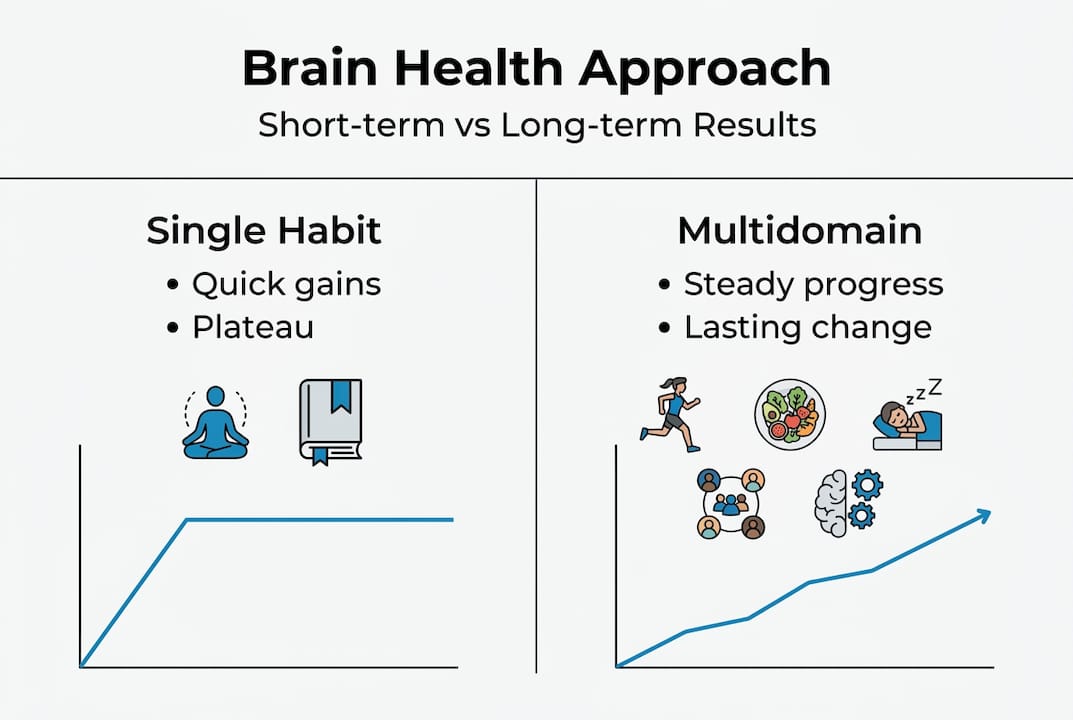
| Approach | Short-term result | Long-term result |
|---|---|---|
| Single habit (e.g., supplements only) | Minimal change | Limited protection |
| Two domains (exercise + diet) | Moderate improvement | Moderate protection |
| Multidomain (all five areas) | Noticeable gains | Strongest cognitive protection |
| Multidomain with structured support | Fastest gains | Best documented outcomes |
Pro Tip: Think of your brain health routine like a five-legged stool. Remove one leg and the whole thing becomes unstable. All five domains need to be present for the structure to hold.
If you are looking for a supplement designed to work alongside this kind of multidomain approach, SuperNatural BrainBoost was formulated specifically to complement an active, health-conscious lifestyle.
Step-by-step: Building your daily brain health routine
Once you have set a solid foundation, it is time to put proven brain health strategies into practice. Here is how to structure them daily and weekly.
1. Move your body for at least 150 minutes per week
Regular aerobic exercise at moderate intensity (think brisk walking, cycling, or swimming) improves memory, executive function, and overall cognition. That works out to about 30 minutes on five days each week. You do not need a gym membership. A consistent walking habit delivers real, measurable results.

2. Follow the MIND diet
The MIND diet (Mediterranean-DASH Intervention for Neurodegenerative Delay) combines the best of two evidence-backed eating patterns. It emphasizes leafy greens, berries, nuts, whole grains, fish, beans, poultry, olive oil, and wine in moderation, while limiting red meat, butter, cheese, pastries, and fried food. MIND diet adherence reduces Alzheimer’s risk by 35 to 53% and is linked to less gray matter shrinkage over time.
3. Protect your sleep
Seven to nine hours of quality sleep each night is not optional for brain health. During deep sleep, the brain’s glymphatic system clears out metabolic waste, including amyloid proteins associated with Alzheimer’s disease. Sleeping under five hours per night doubles dementia risk. Prioritize a consistent bedtime, a cool dark room, and limiting screens in the hour before sleep.
4. Stay socially and mentally engaged
Social engagement reduces cognitive decline risk by reinforcing neural connections, the brain’s internal communication network. Aim for meaningful social interaction several times a week. Pair that with mentally stimulating activities: learning a language, playing an instrument, reading challenging material, or taking a new class.
5. Monitor and manage vascular health
Managing vascular risk factors including hypertension, diabetes, and obesity is one of the most underrated steps in brain protection. High blood pressure damages small blood vessels in the brain over time. Check your numbers regularly, work with your doctor on targets, and avoid smoking and excessive alcohol.
“The brain is deeply vascular. What protects your heart protects your mind.” Keeping blood pressure in a healthy range is one of the most impactful things you can do for long-term cognitive function.
Weekly brain health structure
| Domain | Minimum weekly target | Example activities |
|---|---|---|
| Aerobic exercise | 150 minutes | Walking, cycling, swimming |
| MIND diet | Daily adherence | Leafy greens, berries, fish |
| Sleep | 7 to 9 hours/night | Consistent schedule, dark room |
| Social engagement | 3+ meaningful interactions | Friends, groups, volunteering |
| Mental stimulation | 3+ sessions | Reading, puzzles, new skills |
| Vascular monitoring | Monthly check-in | Blood pressure, weight |
Pro Tip: Stack habits to make them automatic. Walk with a friend (exercise plus social), cook a MIND diet meal while listening to a podcast (nutrition plus mental stimulation). Habit stacking reduces friction and builds consistency faster.
For those who want advanced cognitive support alongside these habits, a well-formulated supplement can serve as a useful complement, not a replacement, for this kind of structured routine.
Are brain supplements worth it? What science really says
While daily habits are the foundation, many wonder if supplements can give their brain an extra boost. The honest answer is nuanced.
Omega-3 fish oil supplements, one of the most popular brain health products, lack strong evidence for preventing cognitive decline in healthy older adults. The benefits seen in research tend to come from eating fish regularly, not from capsules. Food-based nutrients arrive in a complex matrix of co-factors that isolated supplements simply cannot replicate.
That said, not all supplements are created equal. Here is what the evidence currently supports:
- Multivitamins may offer modest slowing of brain aging in older adults, particularly those with nutritional gaps.
- Omega-3s from food (fatty fish two to three times per week) show stronger associations with brain health than supplements.
- Curcumin has shown promise in preclinical and some clinical research for supporting a healthy inflammatory response in the brain, though bioavailability (how well your body absorbs it) is a critical factor.
- Vitamin D and B vitamins may support cognitive function when deficiencies are present.
“No supplement has been proven to prevent dementia. But the right supplement, used alongside strong lifestyle habits, may help fill nutritional gaps and support the conditions your brain needs to thrive.”
Pro Tip: Read supplement labels carefully. Look for products that disclose their ingredient sources, dosages, and absorption technology. Vague claims like “supports brain health” without any explanation of mechanism or dosage are a red flag.
If you are going to add a supplement to your routine, quality matters enormously. We recommend starting with high-quality supplements that are transparent about their formulation and backed by research.
Common mistakes and how to avoid them
Even with the best intentions, a few common missteps can slow your progress. Here is how to troubleshoot and keep your brain health plan on solid ground.
1. Relying on brain games alone
Brain training apps and puzzles improve performance on the tasks you practice, but cognitive training shows limited transfer to real-life cognition when used in isolation. The research is clear: brain games work best when combined with physical exercise. A 30-minute walk followed by a challenging puzzle is more effective than the puzzle alone.
2. Inconsistent sleep
Many people focus on diet and exercise while treating sleep as flexible. This is a critical error. Irregular sleep schedules disrupt the glymphatic clearing process and undermine the memory consolidation that happens during deep sleep. Consistency matters as much as duration.
3. Passive entertainment instead of active engagement
Watching television for hours each day does not stimulate the neural connections that protect against cognitive decline. Active engagement, meaning activities that require you to learn, create, problem-solve, or connect with others, provides far greater protection. Replace passive scrolling with reading, crafting, conversation, or a new skill.
4. Expecting fast results from supplements
Supplements are not fast-acting cognitive enhancers. They work gradually, as part of a broader routine. Expecting dramatic short-term results leads to disappointment and abandonment of otherwise useful habits.
5. Treating the multidomain approach as optional
This is the biggest mistake. Focusing intensely on one area while neglecting others limits your results significantly. The science behind brain-boosting routines consistently shows that the combination of domains is what drives meaningful, lasting protection.
Common mistakes at a glance:
- Skipping exercise and relying solely on supplements or brain games
- Inconsistent sleep schedule, even if total hours seem adequate
- Passive leisure replacing active mental and social engagement
- Ignoring vascular health metrics like blood pressure and blood sugar
- Starting and stopping habits rather than building them gradually
Pro Tip: Set a “brain health minimum” for each week: 150 minutes of movement, five servings of MIND diet foods, and seven hours of sleep per night. These three anchors keep the multidomain approach intact even during busy periods.
What to expect: Signs your brain health routine is working
After building healthy habits and avoiding pitfalls, here is how to tell if your efforts are translating into real cognitive gains.
In the first few weeks:
- Improved mood and reduced mental fatigue
- Better focus during tasks that previously felt draining
- More consistent energy levels throughout the day
- Falling asleep more easily and waking more refreshed
Within two to three months:
- Sharper recall for names, appointments, and details
- Reduced brain fog after meals or in the afternoon
- Greater mental resilience when managing stress
- Noticeable improvement in sleep quality and physical stamina
Over one to two years:
The most compelling evidence comes from the US POINTER trial, which found that structured multidomain interventions can slow cognitive aging by one to two years compared to self-guided approaches. That is not a trivial difference. It means your brain could function like a brain that is one to two years younger than it would otherwise be.
Statistic callout: Participants in structured multidomain lifestyle programs showed measurably better global cognition scores compared to those following general health advice alone.
If you want to support this trajectory with a targeted supplement, the BrainBoost supplement from SuperNatural is designed to complement exactly this kind of evidence-based routine.
Signs you may need to adjust:
- No improvement in energy or focus after 6 to 8 weeks (check sleep and diet consistency first)
- Persistent brain fog despite good habits (consult your doctor to rule out nutritional deficiencies or thyroid issues)
- Difficulty maintaining the routine (simplify and reduce to your minimum anchors)
Why “all-in-one” brain hacks don’t work: consistency and multidomain lifestyle do
Here is something most brain health content will not tell you directly: the supplement industry, the app developers, and the wellness influencers all have a financial incentive to sell you a single, simple solution. A pill. A game. A device. Because a single product is easy to market, easy to sell, and easy to repurchase.
But the science does not support that model. At all.
We have reviewed years of research on cognitive longevity, and the pattern is unmistakable. The people who maintain the sharpest cognitive function into their 70s, 80s, and beyond are not the ones who found the perfect supplement or the best brain training app. They are the ones who built boring, consistent, multidomain habits over decades.
That is not exciting. It does not make a great advertisement. But it is the truth.
The uncomfortable reality is that most “brain hacks” work for a few weeks because novelty itself is stimulating. Then the effect fades, you feel disappointed, and you go looking for the next solution. This cycle is exactly what the research warns against.
What actually works is less glamorous: moving your body most days, eating foods that protect your brain, sleeping enough, staying connected to people you care about, and challenging your mind with things that are genuinely hard. Starting in midlife, before symptoms appear, gives you the longest runway.
Where do supplements fit? Honestly, they are a supporting player, not the lead. A well-formulated product like BrainBoost strategies can help fill nutritional gaps and support the biological conditions your brain needs. But it works because it complements a strong lifestyle foundation, not because it replaces one.
The most honest thing we can tell you is this: there is no shortcut. But the long road is well-marked, well-researched, and absolutely worth walking.
Take your brain health to the next level with SuperNatural
Building strong brain health habits is the most important investment you can make in your cognitive future. And when you are ready to add a science-backed supplement to that foundation, SuperNatural is here to help.
Our BrainBoost supplement is formulated for advanced cognitive support, designed to work alongside the multidomain habits covered in this guide. SuperNatural uses a patented BioSoluble Curcumin process that delivers significantly enhanced bioavailability compared to standard curcumin, so your body actually absorbs what you take. If you want to understand exactly what is in the formula and why it works, learn about SuperNatural BrainBoost and see the research behind every ingredient.
Frequently asked questions
How much exercise do I need for brain health?
Aim for at least 150 minutes weekly of moderate-intensity aerobic activity, such as brisk walking or cycling, for proven cognitive benefits.
Can a healthy diet really lower dementia risk?
Yes. The MIND diet reduces Alzheimer’s risk by 35 to 53% through its emphasis on brain-protective foods like leafy greens, berries, and fish.
Do brain supplements work for everyone?
Most supplements lack strong evidence for preventing cognitive decline in healthy adults; nutrients from whole foods consistently show stronger benefits than isolated supplements.
What’s the most important brain health habit?
No single habit stands alone. Multidomain interventions combining exercise, diet, sleep, and social engagement consistently produce the best outcomes in research.
Does quality sleep really matter for brain health?
Absolutely. Sleeping under five hours per night can double your risk of dementia, making consistent, quality sleep one of the most powerful brain-protective habits you can build.
Recommended
- BrainBoost: Advanced Cognitive Support – SuperNatural
- SuperNatural BrainBoost
- SuperNatural Supplements | BioSoluble® Curcumin™
- BodyControl Overview – SuperNatural
This article is provided for educational and informational purposes only and does not constitute providing medical advice or professional services. Always consult with a qualified and licensed physician or other medical care provider. Statements have not been evaluated by the Food & Drug Administration. This product is not intended to diagnose, treat, cure, or prevent any disease.