

Supplement efficacy is defined as the capacity of a supplement to produce a desired biological or physiological result under controlled, ideal conditions — typically in a clinical trial setting. This is distinct from supplement effectiveness, which measures real-world benefit in free-living people outside of controlled studies. Understanding this difference is the foundation of all industry terminology around supplement efficacy. The FTC’s Competent and Reliable Scientific Evidence (CARSE) standard, Health Canada’s Natural Product Number (NPN) system, and clinical trial design all shape how brands substantiate their claims. If you evaluate supplements for personal use or professional purposes, knowing these terms protects you from misleading marketing.
What is supplement efficacy and how is it measured?
Efficacy relates to clinical trial conditions; effectiveness is the actual observed benefit in free-living people. That distinction matters more than most labels suggest. A supplement can show strong efficacy in a tightly controlled study and still underperform in everyday use because real-world variables like diet, sleep, and medication interactions are never present in a lab.
The FTC’s CARSE standard is the primary regulatory benchmark for supplement claims in the United States. CARSE stands for Competent and Reliable Scientific Evidence, and it requires that claims be backed by studies conducted by qualified experts using accepted scientific methods. One clinical trial is often insufficient for serious health claims; planning at least two trials is considered best practice. This is not a technicality. A single positive study can reflect chance, a flawed design, or a population that does not represent typical users.
Several factors directly influence measured efficacy in clinical trials:
- Dosage: The amount of active ingredient used in a trial must match what appears in the commercial product. A study using 1,000 mg of a compound does not validate a product delivering 200 mg.
- Formulation: The physical form of an ingredient (capsule, liquid, powder, phytosome) affects how the body processes it. Two products with identical ingredients can produce very different trial results based on delivery method alone.
- Active ingredient identity: Standardized extracts with defined percentages of active compounds (such as curcuminoids in turmeric) produce more reproducible results than non-standardized whole-herb preparations.
- Study population: Efficacy results from a study of older adults with a specific deficiency do not automatically transfer to healthy young adults.
Pro Tip: When reviewing a supplement’s clinical evidence, check whether the study used the same dose, form, and population as the product you are considering. If any of those three factors differ, the evidence does not directly apply.
How do “clinically tested” and “clinically proven” differ?
These two phrases appear constantly on supplement packaging, and they do not mean the same thing. Consumers confuse “clinically tested” with “clinically proven”; the latter implies demonstrated efficacy, though both lack precise legal definitions. “Clinically tested” means a product or ingredient was used in a study. It says nothing about whether the study showed a positive result, whether the study was well-designed, or whether the result was statistically significant.

“Clinically proven” carries a stronger implication. It suggests that the clinical evidence demonstrated a clear, reproducible benefit. But because neither term has a strict legal definition under FTC rules, brands sometimes use “clinically tested” to gain credibility without full substantiation. The FTC enforces prior substantiation rules, meaning a brand must hold adequate evidence before making a claim, not after a complaint is filed.
| Term | What It Implies | What It Actually Guarantees |
|---|---|---|
| Clinically tested | A study was conducted | Nothing about results or study quality |
| Clinically proven | Evidence demonstrates benefit | No legal standard; depends on study quality |
| Clinically substantiated | Evidence meets a defined standard | Stronger, but standard varies by context |
| Research-backed | Some research exists | No quality threshold required |
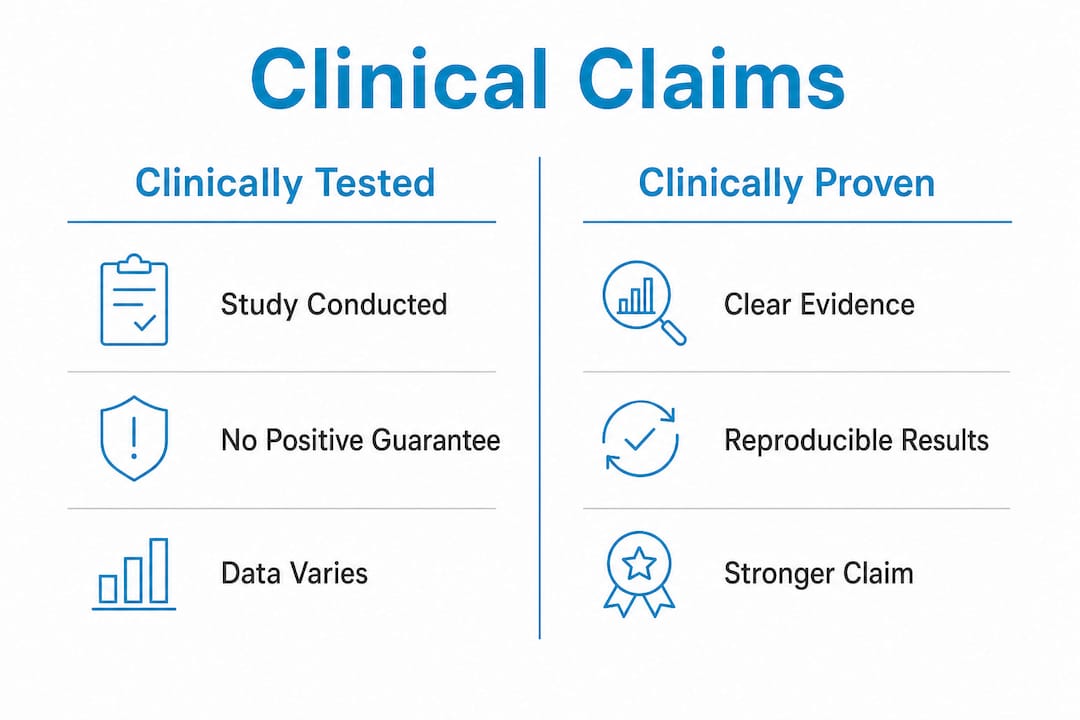
Brands blur the lines between these terms deliberately, which forces you to look at the actual trial data rather than the label. Ask for the study citation, check whether it was peer-reviewed, and confirm the study used the same product formulation being sold.
Pro Tip: Search the study’s DOI or PubMed ID before trusting any clinical claim on a supplement label. If a brand cannot provide a direct citation, treat the claim as unsubstantiated.
What factors affect supplement efficacy beyond clinical trials?
Clinical trial results are the starting point, not the finish line. Bioavailability and bioactivity are distinct and both impact supplement efficacy in ways that trial headlines rarely capture. Bioavailability refers to the proportion of an ingredient that enters circulation. Bioactivity refers to whether that absorbed ingredient actually interacts with the target biological pathway to produce a measurable effect. A supplement can score high on bioavailability and still fail to deliver bioactivity if the absorbed compound does not reach the right tissue or receptor.
Understanding supplement absorption is especially relevant for fat-soluble compounds like curcumin, CoQ10, and vitamin K2, which require dietary fat or specific delivery systems to absorb at meaningful levels.
Additional factors that shape real-world efficacy include:
- Ingredient form: Magnesium glycinate absorbs more readily than magnesium oxide. Methylfolate is more bioavailable than folic acid for people with MTHFR gene variants. The specific chemical form of an ingredient is not a minor detail.
- Delivery method: Liposomal encapsulation, phytosome technology, and patented solubilization processes each change how an ingredient moves through the digestive system. Standard powder capsules often deliver the lowest absorption rates for poorly soluble compounds.
- Dosage at the ingredient level: Safety and efficacy tests must be specific to the supplement’s concentrated ingredient form and dosage. A nutrient that is safe and effective at food-level concentrations may behave differently at the higher doses found in supplements.
- Shelf life and stability: Active compounds degrade over time, particularly when exposed to heat, light, or humidity. A supplement that was potent at manufacture may deliver significantly less active ingredient by the time it reaches the consumer.
- Nutrient interactions: Some ingredients enhance each other’s absorption (vitamin D and vitamin K2; iron and vitamin C). Others compete for the same transport pathways and reduce each other’s uptake when taken together.
These factors explain why enhancing bioavailability is not just a marketing angle. It is a genuine determinant of whether a supplement delivers on its clinical promise in practice.
How do FDA and health canada oversight shape efficacy claims?
Regulatory frameworks in North America do not approve supplements the way they approve pharmaceutical drugs. The FDA does not evaluate supplement efficacy before a product reaches the market. Instead, the FDA monitors post-market safety and acts against products that make unauthorized disease claims or contain undisclosed ingredients. The FTC governs advertising claims and enforces the CARSE standard for any health benefit stated in marketing materials.
Health Canada operates differently. Natural health products sold in Canada must obtain a Natural Product Number (NPN) before going to market. Approval timelines range from 60 days for Class I to over a year for Class III submissions, depending on the complexity of the evidence required. Class I submissions rely on established monographs with pre-accepted safety and efficacy data. Class III submissions require a full scientific review of original clinical evidence.
| Regulatory Body | Jurisdiction | Pre-Market Review | Evidence Standard |
|---|---|---|---|
| FDA (U.S.) | United States | No (post-market only) | CARSE for advertising claims |
| FTC (U.S.) | United States | No | CARSE for health claims in ads |
| Health Canada | Canada | Yes (NPN required) | Class I to III submission tiers |
The practical implication for consumers and industry professionals is significant. An NPN on a Canadian product signals that Health Canada reviewed the evidence before sale. An FDA-compliant U.S. supplement has no equivalent pre-market review. This does not mean U.S. products are inferior, but it does mean the burden of evidence verification falls more heavily on the buyer and the brand. Third-party certification programs like NSF International, USP, and Informed Sport fill part of this gap by verifying label accuracy and manufacturing standards, though third-party label testing does not prove health efficacy. It confirms what is in the bottle, not whether it works.
Key takeaways
Supplement efficacy is the controlled-condition measure of a product’s biological effect, and it is only meaningful when the clinical evidence matches the actual product formulation, dose, and target population.
| Point | Details |
|---|---|
| Efficacy vs. effectiveness | Efficacy is measured in controlled trials; effectiveness reflects real-world outcomes in typical users. |
| CARSE standard | The FTC requires multiple well-designed studies for serious health claims, not just one positive trial. |
| Label term scrutiny | “Clinically tested” and “clinically proven” have no legal definitions; always request the actual study citation. |
| Bioavailability vs. bioactivity | High absorption does not guarantee biological effect; both measures matter for true supplement performance. |
| Regulatory context | Health Canada’s NPN requires pre-market evidence review; FDA oversight in the U.S. is post-market only. |
Why we think most supplement marketing gets efficacy backwards
At SuperNatural Supplements, we have spent years working through the clinical literature on curcumin, and the experience taught us something that most brands prefer not to say out loud: the gap between a supplement’s efficacy in a trial and its performance in your body is often enormous. The industry focuses on finding a positive study and printing it on the label. We focus on closing that gap.
Standard curcumin is a good example. It has hundreds of clinical studies behind it. It also has notoriously poor bioavailability in its natural form, which means most of those studies used delivery systems or doses that bear no resemblance to a standard capsule on a store shelf. The efficacy data is real. The product delivering it to your cells is often not.
That is why we developed BioSoluble® Curcumin™, a patented process that addresses the absorption problem directly rather than citing studies that assume it away. We believe supplement innovation only creates value when it solves a documented biological problem, not when it adds a new claim to a familiar ingredient.
The most honest thing we can tell you is this: a supplement is part of a broader health strategy, not a replacement for one. The evidence-based approach means using products where the formulation matches the clinical evidence, the dose is validated, and the delivery system is designed for the biology you are working with. Everything else is just packaging.
How SuperNatural supplements applies these standards
SuperNatural Supplements builds every product around the principles this article describes. Our BioSoluble® Curcumin™ uses a patented solubilization process that addresses the core bioavailability limitation that undermines standard curcumin products. BodyControl supports detoxification and a healthy inflammatory response. BodyBoost is formulated for immune support, and BrainBoost targets advanced cognitive function. Each product is designed so that the formulation, dose, and delivery method align with the clinical evidence we cite. Visit our product pages to review the specific evidence behind each formula and decide whether it fits your health goals.
FAQ
What is supplement efficacy in simple terms?
Supplement efficacy is the ability of a supplement to produce a specific biological result under controlled conditions, typically demonstrated in a clinical trial. It differs from effectiveness, which measures real-world outcomes in typical users.
What does CARSE mean for supplement claims?
CARSE stands for Competent and Reliable Scientific Evidence, the FTC’s standard for substantiating supplement health claims in U.S. advertising. A single study is rarely sufficient; multiple well-designed trials provide stronger substantiation.
Is “clinically tested” the same as “clinically proven”?
No. “Clinically tested” only confirms that a study was conducted, with no requirement that it showed a positive result. “Clinically proven” implies demonstrated benefit but has no precise legal definition under FTC rules.
Why does bioavailability matter for measuring supplement impact?
Bioavailability determines how much of an ingredient enters your bloodstream, but high bioavailability does not guarantee bioactivity. An absorbed compound must still interact with the correct biological pathway to produce the intended effect.
How does health canada’s NPN differ from FDA oversight?
Health Canada requires a Natural Product Number before a supplement can be sold, meaning evidence is reviewed pre-market. The FDA does not conduct pre-market efficacy reviews for supplements and relies on post-market monitoring instead.
This article is provided for educational and informational purposes only and does not constitute providing medical advice or professional services. Always consult with a qualified and licensed physician or other medical care provider. Statements have not been evaluated by the Food & Drug Administration. This product is not intended to diagnose, treat, cure, or prevent any disease.