

Bioenhanced supplements are formulations scientifically designed to increase how much of a nutrient your body actually absorbs and uses. Standard supplements often deliver far less than their label suggests because digestion and liver metabolism destroy a large portion of the active ingredient before it ever reaches your cells. Defining bioenhanced supplements means understanding that the delivery method matters as much as the ingredient itself. These products use specialized bioenhancer compounds like piperine, advanced delivery systems like liposomes, and technologies like phytosome complexes to push nutrients past the body’s natural absorption barriers. For anyone targeting cognitive function, inflammation, or immune health, this distinction is not a minor detail. It is the difference between a supplement that works and one that does not.
What does “defining bioenhanced supplements” really mean?
Bioenhanced supplements are the industry’s answer to a well-documented problem: supplement bioavailability is the share of a dose that reaches the bloodstream unchanged and usable. Most traditional supplements score poorly on this metric. A standard curcumin capsule, for example, passes through the gut largely unabsorbed because curcumin is poorly water-soluble and breaks down quickly during digestion.
The term “bioenhanced” is a consumer-facing phrase. The recognized industry term is enhanced bioavailability formulation, and you will see it used interchangeably with bioenhanced nutrition products in clinical literature and supplement labeling. Both phrases describe the same core goal: getting more of the active compound into systemic circulation.

Bioavailability claims in supplement launches increased 9% globally between 2020 and 2025. That shift signals a fundamental change in how the supplement industry measures product quality. The focus has moved from how much of an ingredient is in the capsule to how much of it your body can actually use.
How does bioenhancement improve absorption and effectiveness?
Two primary mechanisms drive bioenhancement: bioenhancer compounds and advanced delivery technologies. Understanding both helps you evaluate whether a product’s claims are grounded in science.
Bioenhancer compounds
Piperine improves absorption by inhibiting metabolizing enzymes, specifically CYP3A4 and P-glycoprotein, and by increasing intestinal membrane permeability. It does this without any pharmacological activity of its own. Think of it like propping open a door that would otherwise close before the nutrient gets through. Piperine originated in Ayurvedic medicine and has since been validated by modern pharmacokinetic research as a reliable absorption enhancer.
Advanced delivery systems
Liposomal delivery wraps nutrients in a phospholipid shell that mimics the body’s own cell membranes. This protects the active compound from digestive enzymes and allows it to merge directly with cell walls. Liposomal delivery systems can increase nutrient bioavailability by 3x to 40x compared to standard forms. That is not a marginal improvement. It means a smaller dose can produce a stronger effect.
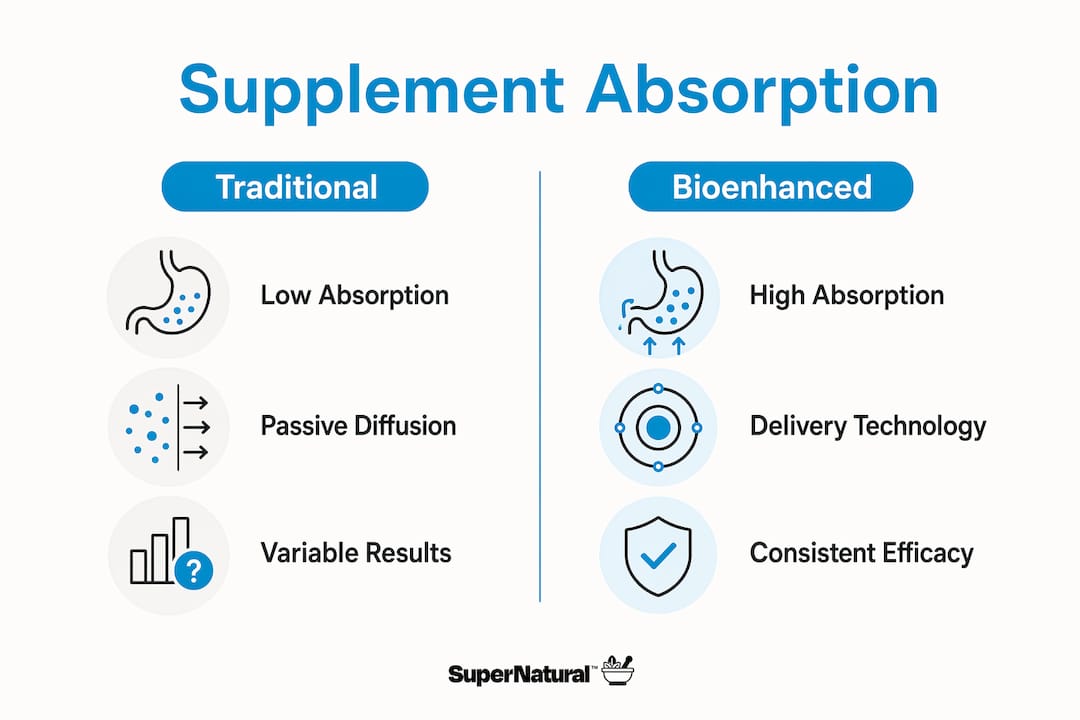
Other technologies include hydrogel matrices, self-emulsifying drug delivery systems (SEDDS), and phytosome complexes. Each is designed for a specific type of nutrient. Self-emulsifying systems suit lipophilic nutrients while phytosome complexes are better for water-insoluble botanicals like curcumin.
Standard oral supplements also face a physiological ceiling. Increasing dose no longer increases blood levels once the gut’s absorption capacity is saturated and the liver’s first-pass metabolism kicks in. Advanced delivery systems bypass this ceiling entirely by routing nutrients around the digestive bottleneck.
Pro Tip: When evaluating a bioenhanced supplement, look for the specific delivery technology named on the label, such as “liposomal,” “phytosome,” or “SEDDS.” A vague claim of “enhanced absorption” without a named mechanism is a red flag.
What are the most effective bioenhanced supplement ingredients?
Several ingredients have strong clinical backing for their bioenhanced formulations. Here is how the most widely used ones work.
- Piperine (BioPerine): Derived from black pepper, piperine inhibits the enzymes that break down nutrients in the gut and liver. It is commonly added to curcumin, resveratrol, and CoQ10 formulations to increase their absorption without altering their effects.
- BioEnhanced R-Lipoic Acid: Standard alpha-lipoic acid degrades quickly in the stomach. The BioEnhanced form uses a stabilized, sodium-bound version (Na-RALA) that survives digestion and reaches the bloodstream intact, improving both uptake and antioxidant activity.
- Liposomal NAD+ precursors: Liposomal NAD+ precursors protect molecules from digestive enzymes and enhance delivery to target tissues, increasing intracellular NAD+ and mitochondrial function. Clinical evidence shows an 84% increase in blood NAD+ levels using liposomal NMN compared to standard forms.
- Curcumin phytosome complexes: Curcumin bound to phosphatidylcholine (as in Meriva or similar phytosome formats) dramatically improves solubility and absorption. SuperNatural Supplements uses a patented BioSoluble Curcumin process that provides significantly enhanced bioavailability compared to standard curcumin.
| Ingredient | Standard form issue | Bioenhanced solution |
|---|---|---|
| Curcumin | Poor water solubility, rapid degradation | Phytosome complex or BioSoluble process |
| NAD+ precursors (NMN/NR) | Digestive enzyme breakdown | Liposomal encapsulation |
| R-Lipoic Acid | Stomach acid instability | Sodium-bound stabilized form (Na-RALA) |
| Resveratrol | Low oral bioavailability | Piperine co-administration or liposomal form |
Bioenhanced vs. traditional supplements: what is the real difference?
The gap between bioenhanced and traditional supplements is not just about absorption percentages. It shows up in real-world outcomes like effective dose size, side effect profiles, and how consistently the product works.
Traditional supplements rely on passive diffusion through the gut wall. This process is inefficient for many compounds, particularly fat-soluble nutrients and large botanical molecules. A person taking a standard 1,500 mg curcumin capsule may absorb only a fraction of that dose. Advanced delivery technologies including hydrogel matrices enable dosage reductions from 1,500 mg to approximately 250–600 mg while maintaining efficacy. Smaller doses mean less filler, lower cost per effective unit, and a reduced chance of gastrointestinal discomfort.
Bioenhanced nutrition products also deliver more consistent results. Because the delivery mechanism controls how the nutrient enters circulation, blood levels are more predictable. This matters most for health goals like cognitive support and inflammation management, where steady nutrient availability at the target tissue drives outcomes.
| Factor | Traditional supplement | Bioenhanced supplement |
|---|---|---|
| Absorption rate | Low to moderate | Significantly higher |
| Required dose | Higher (to compensate for losses) | Lower (due to efficient delivery) |
| Consistency of effect | Variable | More predictable |
| Side effect risk | Higher at large doses | Lower at reduced doses |
| Cost per effective unit | Often higher | Often lower over time |
The role of bioavailability in supplement efficacy is now the starting point for product evaluation, not an afterthought. If a supplement cannot survive digestion and reach your cells, the ingredient quality on the label is largely irrelevant.
How to choose bioenhanced supplements that actually work
Choosing the right bioenhanced dietary aid requires more than reading the front of the label. Here is a practical framework.
- Verify the delivery technology by name. Look for terms like liposomal, phytosome, SEDDS, or a named proprietary system such as BioSoluble Curcumin. Generic “enhanced absorption” language without a mechanism is not evidence of bioenhancement.
- Match the technology to the nutrient. Fat-soluble nutrients like CoQ10 and vitamin D benefit most from self-emulsifying or liposomal systems. Water-insoluble botanicals like curcumin perform best in phytosome or BioSoluble formats. The right delivery method depends entirely on the nutrient’s chemistry.
- Check for clinical validation. A credible bioenhanced product cites human clinical data, not just in vitro (lab dish) studies. Look for published trials showing blood level increases or functional outcomes.
- Understand the dose. A bioenhanced product should require a lower dose than its standard counterpart. If a curcumin product lists 1,500 mg and claims enhanced absorption, ask why the dose is still that high.
- Avoid misleading marketing. Terms like “whole food matrix,” “natural cofactors,” and “synergistic blend” sound scientific but carry no standardized meaning. Stick to products that name their technology and back it with data.
Pro Tip: Cross-reference the supplement’s claimed technology against the supplement efficacy terms used in clinical literature. If the brand’s language matches the science, that is a good sign.
Key takeaways
Bioenhanced supplements work because delivery technology, not dose size, determines how much of a nutrient reaches your cells.
| Point | Details |
|---|---|
| Bioavailability defines efficacy | The share of a dose reaching your bloodstream unchanged is the true measure of supplement quality. |
| Delivery technology matters most | Liposomal, phytosome, and SEDDS systems each suit different nutrient types and health goals. |
| Lower dose can mean better results | Bioenhanced formulations can reduce required doses by up to 80% while maintaining or improving outcomes. |
| Piperine is a proven bioenhancer | Piperine inhibits CYP3A4 and P-glycoprotein enzymes, increasing absorption without pharmacological side effects. |
| Verify claims with named mechanisms | Reject vague “enhanced absorption” language; demand a named, clinically validated delivery technology. |
What we have learned from years of formulating with bioenhanced ingredients
The most persistent misconception we encounter is that a higher milligram count equals a stronger supplement. Consumers see 1,000 mg on one label and 250 mg on another and assume the first is four times more powerful. That logic works for a simple food, not for a compound that faces enzymatic breakdown, poor solubility, and first-pass liver metabolism before it ever reaches the bloodstream.
We put years of research into the BioSoluble Curcumin process precisely because standard curcumin formulations, even at high doses, consistently underdeliver. The science on curcumin’s benefits for inflammation and cognitive health is compelling. The problem was never the ingredient. It was getting enough of it to the cells that need it.
What we find most credible in the current supplement space is the convergence of traditional knowledge and modern pharmacokinetics. Piperine has been used in Ayurvedic medicine for centuries. Modern science explained exactly why it works at the enzyme level. That combination, ancient observation validated by clinical data, is the foundation of trustworthy bioenhancement.
Our honest advice: do not chase the highest dose. Chase the best-documented delivery system for the specific nutrient you need. Check with a doctor before adding any new supplement, especially if you take prescription medications, since bioenhancers like piperine can affect drug metabolism.
— SuperNatural
SuperNatural Supplements and bioenhanced formulations
SuperNatural Supplements builds every product around one principle: absorption first.
The BioSoluble® Curcumin™ process uses a patented technology that delivers curcumin with significantly greater bioavailability than standard curcumin capsules, making it the foundation of BodyControl for inflammation support. BrainBoost is formulated for advanced cognitive support using bioenhanced ingredients chosen for their ability to reach brain tissue effectively. BodyBoost targets immune health with the same absorption-first approach. Each product is designed for people who want their supplements to actually work, not just look impressive on a label. If you are ready to move beyond standard formulations, SuperNatural Supplements offers a clear, science-backed starting point.
FAQ
What are bioenhanced supplements?
Bioenhanced supplements are formulations that use specialized ingredients or delivery technologies to increase how much of a nutrient reaches your bloodstream and cells. The goal is to improve efficacy without simply increasing the dose.
How is piperine used in bioenhanced supplements?
Piperine inhibits the CYP3A4 and P-glycoprotein enzymes that break down nutrients during digestion, increasing absorption without adding pharmacological effects of its own. It is commonly paired with curcumin, resveratrol, and CoQ10.
Are liposomal supplements worth the extra cost?
Liposomal delivery can increase bioavailability by 3x to 40x compared to standard forms, and clinical data shows an 84% increase in blood NAD+ levels with liposomal NMN. For nutrients with poor oral absorption, the cost difference is often justified by the improved outcome.
What is the difference between a phytosome and a liposome?
A phytosome binds a botanical extract to phospholipids to improve solubility, making it best suited for water-insoluble compounds like curcumin. A liposome encapsulates the active ingredient in a phospholipid bubble to protect it from digestion and deliver it directly to cells.
How do I know if a bioenhanced supplement is legitimate?
Look for a named, clinically validated delivery technology on the label, such as liposomal, phytosome, or a patented system like BioSoluble Curcumin. Credible products cite human clinical data showing measurable increases in blood levels or functional outcomes.
This article is provided for educational and informational purposes only and does not constitute providing medical advice or professional services. Always consult with a qualified and licensed physician or other medical care provider. Statements have not been evaluated by the Food & Drug Administration. This product is not intended to diagnose, treat, cure, or prevent any disease.