

Most people assume curcumin works simply because they swallowed it. The science tells a more complicated story. What is curcumin metabolism, exactly? It’s the biological process that determines how much of this compound your body actually converts, absorbs, and puts to work. Understanding curcumin metabolism in the body is the difference between taking a supplement that delivers results and one that passes through you largely unchanged. Your inflammation response, brain health, and antioxidant defenses all depend on what happens after you take curcumin, not just the dose on the label.
Table of Contents
- Key Takeaways
- What is curcumin metabolism: the full process
- Factors that affect curcumin metabolism and bioavailability
- Health benefits driven by curcumin metabolites
- Choosing curcumin supplements for real results
- My perspective on where curcumin metabolism research needs to go
- How SuperNatural approaches curcumin absorption
- FAQ
Key Takeaways
| Point | Details |
|---|---|
| Two-phase metabolism | Curcumin undergoes Phase I reduction and Phase II conjugation before excretion, primarily in the intestines and liver. |
| Very low bioavailability | Over 90% of oral curcumin is excreted unchanged, making formulation technology critical to effectiveness. |
| Metabolites drive benefits | The reduced and conjugated metabolites of curcumin, not the parent compound, largely produce anti-inflammatory and antioxidant effects. |
| Gut microbiota play a role | Your gut bacteria actively convert curcumin into bioactive metabolites that affect systemic health outcomes. |
| Formulation determines outcomes | Delivery technologies like BioSoluble® Curcumin™ significantly improve absorption and metabolic retention compared to standard extracts. |
What is curcumin metabolism: the full process
Understanding how curcumin is metabolized starts with recognizing two distinct phases, each occurring in specific organs with specific enzymes. Think of it like a two-checkpoint security system. Your body processes curcumin before letting it into systemic circulation, and most of it never makes it past the first checkpoint.
Phase I: Reduction in the intestine and liver
Phase I metabolism happens primarily in intestinal cells and hepatic (liver) cells. Enzymes reduce the curcumin molecule stepwise, producing a cascade of metabolites:
- Dihydrocurcumin: the first reduction product, with a slightly modified double bond
- Tetrahydrocurcumin: one of the most studied metabolites, known for strong antioxidant activity
- Hexahydrocurcumin: a further-reduced form with documented anti-inflammatory properties
- Octahydrocurcumin: the most reduced form, representing the endpoint of Phase I
This two-stage metabolic process systematically transforms curcumin’s structure, making it more chemically manageable for the body.
Phase II: Conjugation for excretion
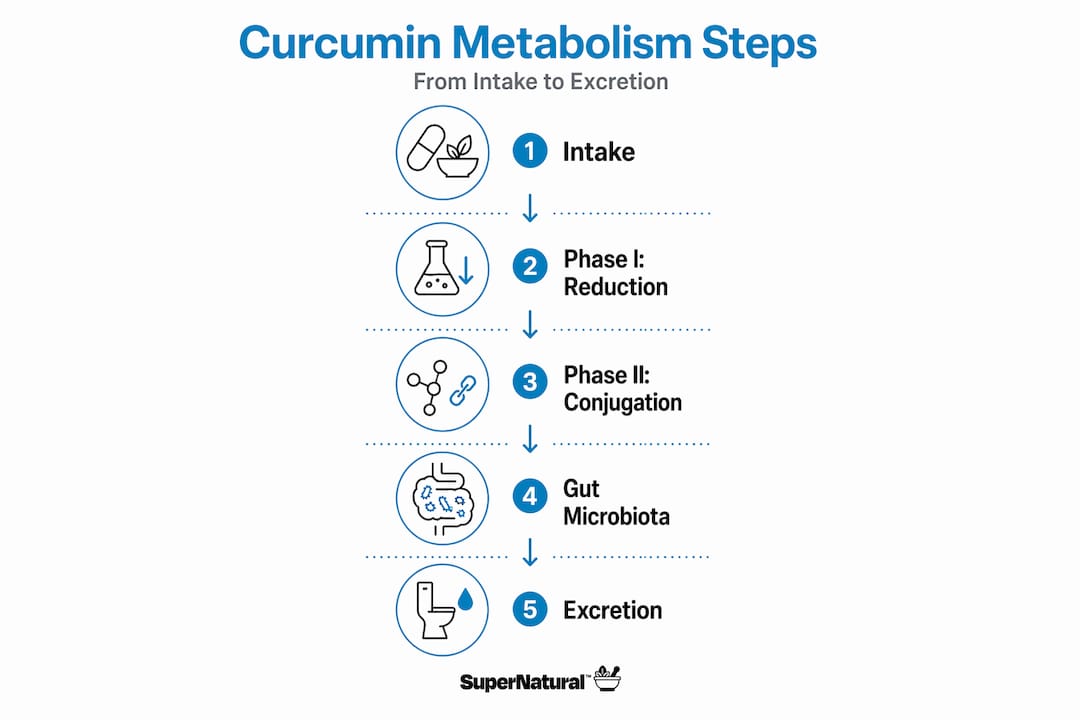
Phase II is where things get water-soluble. Enzymes like UDP-glucuronosyltransferase and sulfotransferase attach glucuronic acid or sulfate groups to the Phase I metabolites. The result is glucuronide and sulfate conjugates that are far more water-soluble than the original curcumin, preparing them for excretion through urine and bile.
Critically, glucuronide conjugates appear in plasma at roughly twice the concentration of sulfate conjugates. What that tells us is that glucuronidation is the dominant clearance pathway. In practical terms, this is why parent curcumin is often undetectable in plasma after oral dosing. The body processes it so quickly that you’re measuring metabolites, not curcumin itself.
The gut microbiota: your third metabolic player
Beyond the intestine and liver, your gut microbiome contributes meaningfully. Specific bacterial strains convert curcumin into dihydrocurcumin and tetrahydrocurcumin through microbial reductase activity. These microbiota-produced metabolites retain biological activity and contribute to systemic effects. The diversity and composition of your gut bacteria directly affect which metabolites you produce, which partly explains why curcumin supplementation results vary so much between individuals.
Pro Tip: Taking curcumin with a diverse, fiber-rich diet supports the gut microbiota populations responsible for producing its most bioactive metabolites.
Factors that affect curcumin metabolism and bioavailability
Here is the core challenge: over 90% of oral curcumin is eliminated in feces largely unchanged. That means on a standard 500 mg dose, roughly 450 mg may never be metabolized in any meaningful way. The curcumin bioavailability factors at play here are both chemical and physiological.
Curcumin’s chemical instability
Curcumin degrades rapidly at physiological pH (around 7.4). Its half-life is under 10 minutes under normal body conditions due to autoxidation and rapid enzymatic breakdown. This is not a flaw that can be fixed with a higher dose. Doubling your intake of an unstable compound does not double the metabolites that reach your tissues.
Key factors that influence metabolic outcomes:
- Enzyme activity variability: Individuals express different levels of UDP-glucuronosyltransferase and CYP450 enzymes, leading to significant person-to-person differences in how curcumin is processed
- Gut microbiota composition: A depleted or dysbiotic microbiome produces fewer active curcumin metabolites
- Food co-ingestion: Consuming curcumin with fats improves dissolution in the GI tract since curcumin is lipophilic (fat-loving)
- Piperine co-administration: Black pepper extract inhibits Phase II conjugation enzymes, slowing clearance and temporarily raising circulating curcumin levels
- Formulation technology: This is the most controllable factor, and the biggest differentiator between products on the market
Technologies that address what affects curcumin metabolism include phospholipid complexes, micellar preparations, nanoparticles, and essential oil blends. BCM-95® combines curcuminoids with turmeric essential oils to enhance both absorption and metabolic retention. The essential oils appear to slow Phase II conjugation, allowing more curcumin to remain in circulation longer. Enhanced delivery systems specifically target these metabolic bottlenecks to improve the clinical utility of curcumin supplementation.
Health benefits driven by curcumin metabolites
The most counterintuitive truth in curcumin science is this: the beneficial effects you want from curcumin are largely not from curcumin itself. The effects of curcumin metabolism, specifically the metabolites it produces, are what drive most of the anti-inflammatory, antioxidant, and neuroprotective outcomes seen in research.
Here’s how that plays out across key health areas:
-
Anti-inflammatory signaling: Curcumin metabolites modulate inflammatory pathways by inhibiting NF-κB, a transcription factor that controls the production of pro-inflammatory cytokines. Studies show that NF-κB inhibition and lipid metabolism modulation are tied to dose-dependent effects, with higher doses (around 200 mg/kg in rodent models) linked to greater neuroprotection and lower doses (around 100 mg/kg) addressing acute inflammation more directly.
-
Antioxidant capacity: Tetrahydrocurcumin, produced during Phase I reduction, consistently outperforms parent curcumin as a free radical scavenger. This metabolite’s structural changes allow it to more efficiently donate electrons and neutralize reactive oxygen species. Maintaining intracellular glutathione balance during this process is critical for sustained antioxidant function.
-
COX-2 and prostaglandin pathways: Reduced curcuminoids like hexahydrocurcumin show antioxidant and anti-inflammatory properties even though their direct inhibitory activity on COX-2 enzymes is lower than the parent compound. The net effect is still meaningful inflammation reduction, just through partially different mechanisms.
-
Neuroprotection and cognitive support: The gut-brain axis matters here. Curcumin metabolites produced by gut bacteria influence neuroinflammation indirectly by improving gut barrier integrity and reducing endotoxin influx. This means better gut metabolism directly supports brain health, which is why bioavailable curcumin benefits extend beyond simple antioxidant activity.
-
Mitochondrial function: Several curcumin metabolites interact with mitochondrial membranes to support energy metabolism and reduce oxidative stress within cells. This connection between curcumin metabolism and cellular energy is still an active area of research.
Pro Tip: If you’re taking curcumin specifically for brain or mood support, prioritize formulations with documented absorption data. Metabolites need to reach systemic circulation to influence neuroinflammation.
Choosing curcumin supplements for real results
Not all curcumin products deliver the same metabolic outcomes. Here is a straightforward comparison to help you evaluate what you’re actually buying:
| Product type | Curcuminoid content | Delivery technology | Expected bioavailability |
|---|---|---|---|
| Turmeric powder (food/spice) | 2-5% curcuminoids | None | Very low |
| Standardized curcumin extract | 95% curcuminoids | None | Low (poor absorption) |
| Piperine-enhanced extract | 95% curcuminoids | Piperine (BioPerine®) | Moderately improved |
| Phytosome or phospholipid complex | 18-20% curcuminoids | Lipid carrier | Good improvement |
| Essential oil blend (e.g., BCM-95®) | 86% curcuminoids | Turmeric essential oils | Significantly improved |
| BioSoluble® delivery format | High curcuminoid content | Patented solubilization | Maximum absorption |
Delivery technology matters more than raw curcuminoid percentage. A product listing “95% standardized extract” sounds impressive but delivers far less than a well-formulated product at 86% with a proper delivery system.
When evaluating labels, look for these specifics:
- Named delivery technology (not just “enhanced absorption”)
- Third-party testing or clinical data on bioavailability
- Clear curcuminoid content in milligrams per serving, not just as a percentage of turmeric extract
- Transparency about what the “enhanced bioavailability” claim actually refers to
Product labels can mislead consumers; “enhanced bioavailability” sometimes means only that piperine was added, which slows Phase II clearance rather than improving actual absorption at the intestinal level. Understanding the curcumin digestion process helps you see through vague marketing language. You can also explore how curcumin absorption works in more depth to sharpen your evaluation skills.
My perspective on where curcumin metabolism research needs to go
I’ve spent years watching people invest in curcumin supplements and wonder why they aren’t feeling a difference. In my experience, the answer almost always comes back to metabolism, not the curcumin itself.
The field has been too focused on measuring parent curcumin in plasma and calling it bioavailability. That framing misses the point entirely. Curcumin’s therapeutic effects arise from its biological promiscuity, meaning it interacts with multiple pathways simultaneously through its metabolites. Chasing plasma curcumin levels is like measuring how much coffee you smelled instead of how much caffeine you absorbed.
What I’ve found actually works is shifting the conversation to metabolite profiling. Individual variability in gut microbiota and enzyme expression means that two people taking the same supplement can have completely different metabolic outcomes. That’s not a disclaimer. It’s a clinical reality that should drive personalized supplementation decisions.
My take on dosing: more is not always better. Research showing neuroprotective effects at higher doses and anti-inflammatory effects at lower doses suggests that therapeutic goals should guide dosage, not arbitrary “more is more” thinking. We need better clinical data on what dose achieves which metabolic outcomes in humans, not just rodents.
The most promising near-term direction is combining metabolite profiling with gut microbiome analysis to guide curcumin supplementation. Until that becomes standard practice, choosing a formulation with proven delivery technology is the most reliable way to close the gap between what you take and what your body can actually use.
— SuperNatural
How SuperNatural approaches curcumin absorption
At SuperNatural Supplements, we built our BioSoluble® Curcumin™ formulation specifically to address the metabolic bottlenecks this article describes. Our patented process dramatically improves solubility and intestinal uptake compared to standard extracts, meaning more curcumin reaches the Phase I metabolic sites where it gets converted into the active forms your body actually uses. It’s not about putting more curcumin in the capsule. It’s about getting more to work.
For those focused on cognitive health, BrainBoost is formulated with advanced cognitive support in mind, drawing on BioSoluble® technology to support neuroprotective pathways. If immune function is your priority, BodyBoost delivers targeted immune support. Every product in our line is designed around the science of absorption, not just ingredient lists.
FAQ
What is curcumin metabolism in simple terms?
Curcumin metabolism is the process by which your body chemically transforms curcumin into smaller compounds, primarily through reduction reactions in the intestines and liver and then conjugation for excretion. These transformed metabolites are what produce most of curcumin’s health effects.
Why does curcumin have such low bioavailability?
Curcumin degrades rapidly at physiological pH and has a half-life under 10 minutes in the body, with over 90% of an oral dose excreted in feces unchanged. Formulation technology is the primary way to improve how much actually gets absorbed and metabolized.
Do curcumin metabolites still provide health benefits?
Yes. Metabolites like tetrahydrocurcumin are strong antioxidants, and multiple reduced curcuminoids retain anti-inflammatory properties that contribute to the compound’s overall effects on inflammation and cellular health.
How does the gut microbiome affect curcumin metabolism?
Gut bacteria convert curcumin into bioactive metabolites including dihydrocurcumin and tetrahydrocurcumin, and curcumin itself modulates microbiome composition and barrier integrity. A healthier, more diverse microbiome generally produces more and better curcumin metabolites.
What should I look for in a curcumin supplement for better metabolism?
Prioritize named delivery technologies over raw curcuminoid percentages. Look for products with clinical bioavailability data, transparent labeling about curcuminoid content in milligrams, and a documented mechanism for improving intestinal absorption rather than just generic “enhanced bioavailability” claims.
This article is provided for educational and informational purposes only and does not constitute providing medical advice or professional services. Always consult with a qualified and licensed physician or other medical care provider. Statements have not been evaluated by the Food & Drug Administration. This product is not intended to diagnose, treat, cure, or prevent any disease.