

Concentration is the ability to direct sustained mental attention toward a single task while filtering out competing stimuli. Improving it is not about willpower alone. Research from Stanford Medicine and Harvard Health shows that the most effective strategies for sustained focus combine environmental controls, structured timing, and foundational lifestyle habits. This guide to boosting concentration gives you the specific, science-backed methods that actually move the needle, whether you are studying, working, or trying to stay sharp through a long afternoon.
How does managing distractions improve your concentration?
Distraction management is the single highest-leverage change you can make to your focus. The reason is straightforward: resisting temptation is far less effective than removing the temptation before it appears. Stanford Medicine experts call this “proactive control,” and it works because your brain never has to spend energy fighting the urge to check your phone if the phone is not in the room.
Here is what proactive distraction control looks like in practice:
- Move your smartphone to another room. Stanford Medicine recommends physically removing your phone during focus blocks. Even a face-down phone on your desk creates a low-level pull on your attention.
- Silence all non-essential notifications. Healthline endorses turning off alerts as part of a complete distraction control method alongside structured timing techniques.
- Set up a dedicated workspace. A consistent physical environment trains your brain to associate that space with focused work. Keep it clear of visual clutter, which competes for your attention the same way a buzzing phone does.
- Use website blockers during focus sessions. Tools like Freedom or Cold Turkey let you schedule blocks on social media and news sites so the temptation never loads in the first place.
Pro Tip: Tell the people around you when your focus block starts and ends. A simple “I’m heads-down until 11 a.m.” prevents interruptions without requiring you to be rude or ignore anyone.
Combining environment control with structured focus periods produces better results than either approach alone. Think of it like wanting a strong cup of coffee instead of just sniffing the beans. The setup has to be complete to work.

What are the best timing techniques to sustain focus?
Attention does not hold steady for hours. Attention begins to decline approximately 10 minutes after starting a task, which means most people are fighting a losing battle when they try to power through 90-minute blocks without a break. The fix is to schedule breaks before your focus collapses, not after.
The most widely validated framework for this is the Pomodoro Technique, developed by Francesco Cirillo in the late 1980s. Here is how it works:
- Choose one task to work on.
- Set a timer for 25 minutes and work without interruption.
- When the timer rings, take a 5-minute break. Stand up, stretch, or step outside.
- After four complete cycles, take a longer break of 20–30 minutes.
- Repeat the cycle for the duration of your work session.
Stanford Medicine recommends blocking time for regular breaks to sustain attention across a full workday. The Pomodoro Technique operationalizes exactly that.
Pro Tip: Track when your mind actually wanders during a session. If you consistently lose focus at the 18-minute mark, shorten your intervals to 18 minutes. Personalizing your Pomodoro timing to your real attention span improves both adherence and results.
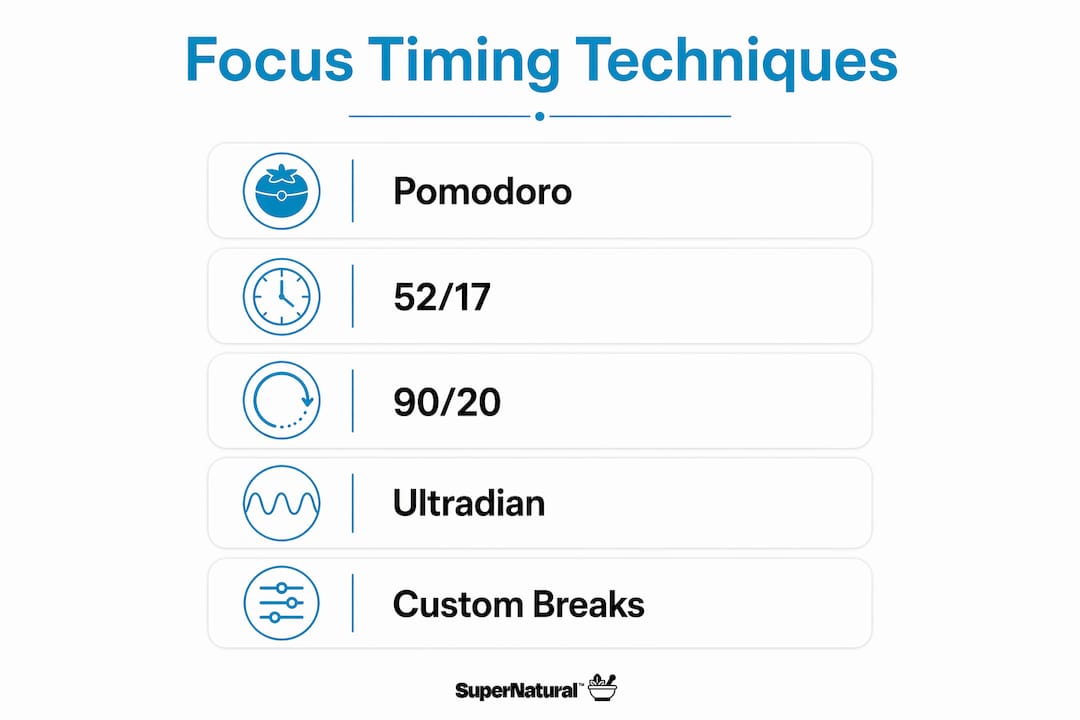
Here is a quick comparison of common timing approaches:
| Technique | Work Interval | Break Length | Best For |
|---|---|---|---|
| Pomodoro | 25 minutes | 5 minutes | Deep work, writing, studying |
| 52/17 Method | 52 minutes | 17 minutes | Longer analytical tasks |
| Ultradian Rhythm | 90 minutes | 20 minutes | Creative or research work |
| Personalized Pomodoro | Tracked individually | 5–10 minutes | Anyone who has mapped their attention span |
The key insight across all of these methods is the same. Breaks are not a reward for finishing work. They are a required input for sustained cognitive performance.
Which lifestyle habits support better concentration?
The behavioral strategies above work best when your brain has the raw materials it needs to focus. Sleep, hydration, nutrition, and movement are not soft lifestyle advice. They are the biological foundation of attention. Harvard Business Review identifies sleep, hydration, and movement as the core elements of any reliable focus ritual.
Here is what the research supports:
- Sleep. Cognitive performance degrades measurably after fewer than seven hours of sleep. Prioritize a consistent sleep schedule over weekend catch-up sleep, which does not fully restore attention capacity.
- Hydration. Even mild dehydration impairs working memory and attention. Keep water at your desk and drink before you feel thirsty.
- Nutrition timing. Large meals spike blood sugar and then crash it, taking your focus with it. Smaller, balanced meals with protein and healthy fats sustain steadier mental energy across the day.
- Brief exercise. A 10-minute walk increases blood flow to the prefrontal cortex, the brain region most responsible for attention and decision-making. Harvard Health identifies this as one of the fastest on-the-spot ways to restore focus.
You can also explore how brain health habits compound over time when these lifestyle elements are practiced consistently. The compounding effect is real. One good night of sleep helps. Three weeks of consistent sleep, hydration, and daily movement creates a noticeably sharper baseline.
How can goal-setting and mindfulness improve your focus?
Mental clutter is one of the most underrated enemies of concentration. When your brain is holding a dozen unfinished tasks, reminders, and worries in working memory, there is simply less cognitive bandwidth available for the task in front of you. Two practices address this directly: structured task management and mindfulness.
On the task management side, Harvard Health recommends using short, refreshed task lists rather than long, sprawling to-do lists. A list of three to five prioritized items reduces anxiety and gives your brain a clear target. When a new idea or reminder pops into your head mid-task, write it down immediately rather than trying to hold it in memory. This single habit prevents the internal interruptions that derail focus more often than external ones.
On the multitasking question, the evidence is unambiguous. Harvard Health states that multitasking reduces attention and slows task completion. Single-tasking, meaning working on one item until it is done or until a scheduled break, produces better output and less mental fatigue.
Mindfulness practices round out this section. Even five minutes of focused breathing before a work session lowers cortisol and primes the prefrontal cortex for sustained attention. Apps like Headspace, Calm, and Insight Timer all offer short, guided sessions designed specifically for pre-work focus. You do not need a meditation practice. You need a two-minute breathing exercise before you open your laptop.
“The goal is not to clear your mind permanently. The goal is to give your attention a single, clear place to land.”
Focus rituals also matter here. A consistent pre-work sequence, such as making tea, reviewing your short task list, and doing two minutes of breathing, creates a reliable cue that tells your brain it is time to concentrate. Consistency is what makes the ritual work. The specific actions matter less than doing them in the same order every time.
Key takeaways
Sustained concentration depends on removing distractions before they appear, timing breaks to match your natural attention rhythms, and building the lifestyle foundation that makes focus biologically possible.
| Point | Details |
|---|---|
| Remove distractions proactively | Move your phone out of the room before your focus session starts, not after distraction hits. |
| Use structured timing | The Pomodoro Technique (25-minute intervals, 5-minute breaks) aligns work blocks with natural attention limits. |
| Build the lifestyle foundation | Sleep, hydration, and a 10-minute walk are the fastest ways to restore and sustain cognitive performance. |
| Manage mental clutter | Short task lists and writing down off-task ideas free up working memory for the task at hand. |
| Pair mindfulness with rituals | A consistent pre-work sequence primes the brain for focus more reliably than willpower alone. |
What we have learned about concentration that most guides miss
At SuperNatural Supplements, we have spent years looking at the intersection of lifestyle, nutrition, and cognitive performance. One pattern stands out clearly: most people fail at focus not because they lack discipline, but because they try to add focus strategies on top of a depleted system.
The conventional advice tells you to try harder, use a timer, and meditate. That advice is not wrong. But it skips the part where your brain needs adequate sleep, real hydration, and anti-inflammatory nutritional support before any behavioral technique will stick. You can run the Pomodoro Technique perfectly and still feel foggy if you slept five hours and skipped breakfast.
We also see people abandon good focus habits after a few days because they expect immediate transformation. Concentration is a skill that rebuilds gradually. Start with one change: move your phone out of the room for your first work hour tomorrow. That single shift, done consistently for two weeks, will do more for your focus than downloading five productivity apps.
The other thing most guides miss is the role of neuroinflammation in cognitive fog. Chronic low-grade inflammation affects the prefrontal cortex directly, making sustained attention harder even when your habits are otherwise solid. This is where targeted nutritional support, specifically curcumin’s impact on brain function, becomes a meaningful complement to behavioral strategies rather than a replacement for them.
Support your focus routine with BrainBoost
The behavioral strategies in this article work. They work even better when your brain has the nutritional support it needs to sustain attention across a full day.
SuperNatural Supplements developed BrainBoost specifically for advanced cognitive support. It uses the patented BioSoluble Curcumin process, which delivers significantly higher bioavailability than standard curcumin. Think of standard curcumin like sniffing the coffee beans. BioSoluble® Curcumin™ is the actual cup. The difference in absorption is what makes the cognitive support meaningful rather than marginal. BrainBoost is designed to complement the focus habits you are building, not replace them. Pair it with your distraction controls, your Pomodoro sessions, and your sleep routine for the most complete approach to sustained concentration.
FAQ
What is the fastest way to improve concentration right now?
A 10-minute walk increases blood flow to the prefrontal cortex and is one of the quickest on-the-spot ways to restore focus. Moving your phone to another room before starting work is the second most immediate change you can make.
How long can a person realistically focus without a break?
Attention begins to decline around the 10-minute mark for many people, though some can sustain focus for up to 25 minutes. Harvard Health recommends planning breaks around natural attention waning rather than waiting until focus collapses.
Does multitasking hurt concentration?
Yes. Harvard Health confirms that multitasking reduces attention and slows task completion. Single-tasking on one item until it is done or until a scheduled break produces better results.
Can supplements support better focus?
Nutritional support can complement behavioral focus strategies, particularly when neuroinflammation contributes to cognitive fog. SuperNatural Supplements’ BrainBoost uses BioSoluble® Curcumin™ to support cognitive function alongside lifestyle habits. Always consult a qualified physician before starting any supplement.
How does the pomodoro technique improve focus?
The Pomodoro Technique structures work into 25-minute intervals followed by 5-minute breaks, aligning effort with natural attention rhythms. Healthline endorses it as an effective focus training framework when combined with distraction controls like silencing notifications.
This article is provided for educational and informational purposes only and does not constitute providing medical advice or professional services. Always consult with a qualified and licensed physician or other medical care provider. Statements have not been evaluated by the Food & Drug Administration. This product is not intended to diagnose, treat, cure, or prevent any disease.