

Most health-conscious people take supplements with good intentions but without a clear strategy. You buy what sounds promising, take it inconsistently, and wonder why you’re not feeling different. The reality is that knowing how to create a daily supplement plan is just as important as choosing what goes into it. About 75% of Americans take at least one dietary supplement, yet many do so without ever assessing their actual needs. This guide gives you a structured, evidence-based approach to building a daily supplement routine that genuinely supports focus, reduces inflammation, and improves your overall well-being.
Table of Contents
- Understanding your supplement baseline and goals
- Choosing supplements: prioritizing effectiveness and safety
- Structuring your daily supplement routine for optimal absorption and convenience
- Monitoring progress and adjusting your plan for sustained success
- The hidden risks and overlooked truths about daily supplements
- Explore SuperNatural’s curated supplements to support your daily plan
- Frequently asked questions
Key Takeaways
| Point | Details |
|---|---|
| Assess your baseline | Start by evaluating your diet and nutrient levels to identify specific supplement needs. |
| Follow clinical guidance | Use supplements only as recommended by experts to avoid unnecessary or harmful intake. |
| Time your supplements | Take supplements at optimal times and separate conflicting nutrients for better absorption. |
| Start with few supplements | Begin with 1-3 supplements and monitor your body’s response before adding more. |
| Choose quality products | Select supplements with third-party testing and clear labeling for safety and effectiveness. |
Understanding your supplement baseline and goals
Now that you understand why a plan matters, the next step is assessing where you stand and what you want to achieve.
Before you add a single capsule to your morning routine, you need honest answers to two questions: What does your diet actually provide? And what specific health outcomes are you targeting? Skipping this step is how people end up taking five supplements that partially overlap, miss the nutrient they actually need, and spend money without seeing results.
A practical baseline assessment looks like this:
- Evaluate your diet first. Aim to meet at least 50% of your micronutrient needs through whole foods before you consider supplementation. A registered dietitian or a detailed food-tracking app can help you identify real gaps.
- Request targeted blood work. A comprehensive panel covering vitamin D, B12, iron, magnesium, and inflammatory markers like CRP (C-reactive protein) gives you data, not guesswork. Experts recommend a food-first approach and using supplements to close persistent gaps identified through blood work.
- Define your health goals clearly. “Better focus” is vague. “Reducing afternoon brain fog and supporting working memory” is actionable. The same goes for inflammation control or immune support.
- Treat supplements as targeted tools. They fill specific gaps or provide specific benefits. They are not a substitute for a nutrient-dense diet.
When you approach tailoring supplement plans this way, you stop guessing and start building something that actually fits your biology and lifestyle.
Pro Tip: Ask your doctor to test ferritin (stored iron), not just serum iron. Many people show normal iron levels but have depleted ferritin, which directly affects energy and cognitive function.
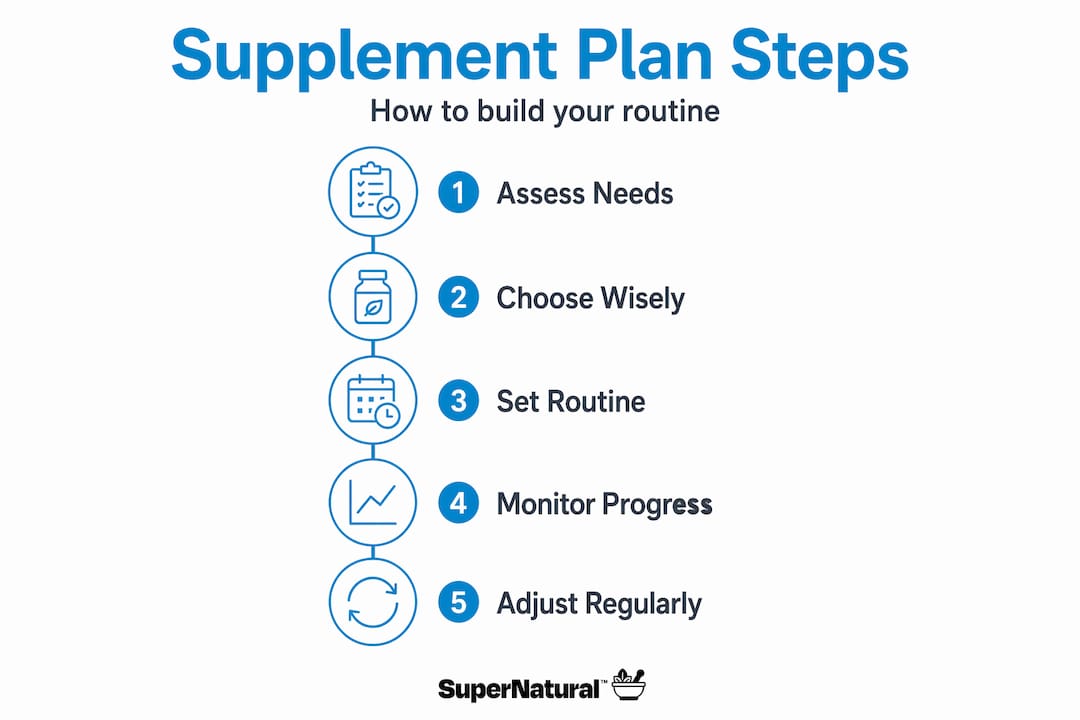
Choosing supplements: prioritizing effectiveness and safety
With your goals set, the next crucial step is selecting supplements that are both safe and effective.
Not everything on the supplement shelf belongs in your plan. The supplement industry is largely self-regulated, which means the burden of smart selection falls on you. Making good choices here protects your health and your wallet.
- Follow clinical guidelines, not trends. For example, healthy adults aged 19 to 74 generally do not need routine vitamin D supplementation unless a deficiency is confirmed. Taking it “just in case” adds cost and potential risk.
- Respect upper safety limits. Fat-soluble vitamins (A, D, E, and K) accumulate in tissue rather than flushing out like water-soluble vitamins. The vitamin D upper safe limit is 4,000 IU per day. Exceeding this regularly can cause hypercalcemia (excess calcium in the blood), contributing to kidney stones and cardiovascular complications.
- Know the dangerous pairings. Some supplements blunt each other’s effectiveness or interact with medications. Blood thinners, for instance, interact with fish oil and vitamin K. St. John’s Wort affects the metabolism of dozens of medications.
- Avoid redundancy. If your multivitamin already contains 100% of your daily B12, adding a separate B12 supplement rarely adds benefit and occasionally creates excess.
- Look for evidence of bioavailability. A supplement that your body cannot absorb is like, as we often say, wanting a strong cup of coffee and only sniffing the beans. Bioavailability (how much of a nutrient actually reaches your bloodstream) varies enormously between forms of the same nutrient.
“Choosing the right supplement means understanding both what you need and what the product actually delivers. Always verify the form of the nutrient, not just the dose on the label.”
Learning the details of supplement benefits and safety before you buy is the single most effective way to avoid wasted money and unnecessary risk.
Structuring your daily supplement routine for optimal absorption and convenience
Knowing what supplements to take leads to the next step: how to take them correctly every day for maximum benefit.

Timing is not a minor detail. Some nutrients compete for the same absorption pathways. Others need specific conditions, like dietary fat or an empty stomach, to work properly. Getting this wrong can quietly undermine an otherwise well-chosen plan.
Here is a practical daily framework:
- Morning with breakfast (fat-containing meal): Take fat-soluble vitamins A, D, E, and K. Fat in the meal triggers bile release, which is required to absorb these nutrients properly.
- Morning on an empty stomach or between meals: Take water-soluble vitamins like B-complex and vitamin C. These absorb better without food competing for uptake.
- Midday or with lunch: Take magnesium glycinate if you use it for daytime muscle or nerve support.
- Evening meal: Keep evening supplements minimal. If you take calcium, this is a reasonable time, but keep it separate from iron by at least four hours.
- Before bed: Magnesium (if using for sleep support) and certain adaptogens work well at night when the body is in recovery mode.
| Supplement | Best timing | Take with or without food |
|---|---|---|
| Vitamin D | Morning | With a fat-containing meal |
| B-complex | Morning | Empty stomach or light meal |
| Vitamin C | Morning or midday | Either, but away from iron if needed |
| Iron | Morning or midday | Empty stomach, with vitamin C |
| Calcium | Evening | With food, separate from iron |
| Magnesium | Evening or bedtime | With or without food |
| Omega-3 | With any meal | With food to reduce fishy aftertaste |
| Curcumin | With a fat-containing meal | Always with food for absorption |
One of the most common structure mistakes we see is calcium and iron taken at the same time. Calcium actively blocks iron absorption when taken together. Separating them by at least four hours is not optional if you need both.
Understanding absorption considerations and timing collisions is especially relevant for nutrients like curcumin, which has notoriously poor bioavailability in standard forms without specific delivery technology.
Building a routine around brain health also benefits from this structured approach, since cognitive supplements often work best when taken consistently at the same time each day.
Pro Tip: A new health habit takes an average of 66 days to become automatic. Start with 1 to 3 supplements and wait at least four weeks before adding more. This also lets you identify which supplement is causing any side effect if one appears.
Monitoring progress and adjusting your plan for sustained success
Once you have your routine established, ongoing monitoring ensures your plan stays safe and effective.
A supplement plan is not something you set up once and forget. Your needs shift with age, diet changes, stress levels, and health status. Regular check-ins with both your body and your lab results are what separate a plan that works from one that quietly becomes outdated.
How to track effectively:
- Keep a simple supplement log. Note what you take, when, and any noticeable changes in energy, focus, mood, or digestion.
- Schedule a blood panel around 12 weeks after starting a new supplement protocol. Regular biomarker testing every 12 weeks initially, then annually, helps track nutrient status and guide adjustments with real data.
- Pay attention to early warning signals. Nausea, headaches, unusual fatigue, or changes in stool color can indicate a dosage issue or absorption problem.
- Assess your goals quarterly. Are your focus levels where you want them? Are inflammatory markers improving? Is your immune response stronger through cold and flu season?
Red flags that warrant a prompt review with your doctor:
- Persistent digestive discomfort after starting a new supplement
- New symptoms that coincide with a dosage increase
- Blood test results outside normal range for nutrients you are actively supplementing
- Any new prescription medication (interactions are common and under-recognized)
Staying proactive with monitoring nutrient gaps and supplement adjustments is what makes the difference between a plan that delivers results year after year and one that fades into another forgotten routine.
The hidden risks and overlooked truths about daily supplements
We want to be straightforward with you about something most supplement guides skip: the supplement world has real pitfalls, and knowing them is as valuable as knowing which nutrients to take.
The first underappreciated hazard is timing collisions. Most people are aware that supplements can interact with medications. Fewer realize that supplements can interfere with each other. Competing nutrients taken together can lead to significantly reduced absorption, meaning you are paying for a supplement that your body largely ignores. Calcium and zinc, for example, share an absorption pathway. Iron and zinc do too. Taking them together is not dangerous, but it is inefficient in a way most people never discover.
The second issue is quality. Unlike pharmaceuticals, supplements do not require FDA pre-market approval. Label inaccuracies are common, and the dose on the bottle is not always what you are actually getting. This is why third-party testing and Certificates of Analysis (documents that verify a product’s contents independently) are non-negotiable for us at SuperNatural. Always look for products that provide these transparently.
Third, and perhaps most important, simpler is often better. We have seen health-conscious individuals build supplement stacks of 12 or more products, chasing every marginal benefit. The research consistently shows that a small number of well-chosen, well-timed, high-bioavailability supplements outperforms an overwhelming stack that no one can maintain consistently. Sustainability is a health strategy.
Finally, supplements work best when they complement common supplement mistakes that undermine a nutrient-dense whole-food diet, not replace it. No capsule replaces the phytonutrients, fiber, and synergistic compounds found in real food. Build your foundation in the kitchen, then use supplements to address what food cannot fully provide.
Explore SuperNatural’s curated supplements to support your daily plan
Building a supplement plan with integrity means choosing products you can trust. At SuperNatural, we put years of research into formulations designed specifically for the goals this guide covers: focus, inflammation support, and overall wellness.
Our BioSoluble® Curcumin™ uses a patented process that dramatically increases bioavailability compared to standard curcumin, making it genuinely effective for a healthy inflammatory response rather than just another supplement that passes through unabsorbed. BrainBoost delivers advanced cognitive support compounds for sharper focus and mental clarity. And BodyBoost is formulated to support superior immune function, complementing a well-rounded daily routine. Every product undergoes rigorous quality testing with third-party verification, so you always know exactly what you are getting.
Frequently asked questions
How many supplements should I start with when creating a daily plan?
Start with 1 to 3 supplements and wait at least four weeks before adding more. This approach gives your body time to respond and makes it easier to spot any reactions, since new health behaviors take an average of 66 days to become automatic.
Is routine vitamin D supplementation necessary for healthy adults?
Generally, no. Healthy adults aged 19 to 74 without a confirmed deficiency do not need routine vitamin D supplementation based on updated 2024 clinical guidelines. Get tested before supplementing.
What are the risks of taking too much vitamin D?
Exceeding 4,000 IU daily can cause vitamin D toxicity, leading to hypercalcemia (excess calcium in the blood), nausea, confusion, and in severe cases, kidney stones.
Can supplements interact with each other or medications?
Yes, and this is more common than most people realize. Certain supplements like St. John’s Wort and iron can interfere with medications and each other’s absorption. Always consult a healthcare provider before adding new supplements, especially if you take prescription medications.
How can I ensure the quality of the supplements I buy?
Look for third-party testing and Certificates of Analysis, which are independent lab documents confirming a product’s actual contents. Label inaccuracies are common in the supplement industry, and third-party verification is your most reliable safeguard against products that do not deliver what they promise.