

The complex topic of supplement science sits at an uncomfortable intersection of genuine research, regulatory gaps, and marketing that often moves faster than the evidence. A 2026 Nature briefing found that dose and compound variation alone make comparing supplement studies genuinely difficult, even for scientists. If you’re trying to cut through the noise on supplements for focus and inflammation, you’re not being impatient. The science really is that complicated, and most articles won’t tell you why.
Table of Contents
- Understanding the science behind supplements
- The realities of supplements for brain focus and inflammation
- Advanced formulations: BioSoluble Curcumin and bioavailability
- Practical guide to choosing and using supplements responsibly
- Why the supplement industry’s complexity requires informed skepticism
- Explore BioSoluble® Curcumin™ and other advanced supplements
- Frequently asked questions
Key Takeaways
| Point | Details |
|---|---|
| Supplements have complex evidence | Scientific support for supplements varies widely due to formulation differences and limited regulation. |
| Focus on verified needs | Supplements best serve those with diagnosed deficiencies or condition-specific needs, not broad wellness claims. |
| Bioavailability matters | Advanced formulations like BioSoluble Curcumin improve absorption, which is crucial for clinical effectiveness. |
| Consult healthcare providers | Always discuss supplements with medical professionals to ensure safety and appropriate use. |
| Industry demands skepticism | Supplement marketing often outpaces science, requiring consumers to critically evaluate products. |
Understanding the science behind supplements
To truly grasp supplement science, it’s important to understand how these products are regulated and studied differently than medications. This isn’t a minor administrative distinction. It shapes everything you see on a label, everything a brand is allowed to claim, and how much confidence you can place in those claims.
Start with the regulatory reality. In the United States, dietary supplements are regulated as foods, not drugs. That means manufacturers don’t need to prove a product works before putting it on shelves. They need to demonstrate it’s safe, but efficacy? That responsibility largely shifts to the consumer and their ability to parse the evidence independently.
Then there’s the claims structure. Supplement brands are permitted to make “structure/function claims,” meaning they can say a product “supports healthy inflammatory response” without proving it prevents or treats any disease. That’s not fraud. It’s the legal framework, and it’s why so much label language sounds confident without being clinically specific.
The research itself is also fragmented. Dosage and compound variation across studies make direct comparisons difficult. A clinical trial using 500mg of curcumin in a standard extract looks nothing like a trial using 200mg of a high-bioavailability form, yet both might be cited to support “curcumin benefits” claims. When you read the research on natural supplements explained in detail, you start to see why identical headlines can come from wildly different study designs.
Key regulatory and scientific challenges to understand:
- No premarket efficacy approval required for dietary supplements in the US
- Structure/function claims are broadly allowed without disease-prevention proof
- Inconsistent formulations across studies create evidence that’s hard to compare
- Industry-funded research can introduce bias that peer review doesn’t always catch
“When you’re evaluating a supplement’s evidence base, the first question isn’t ‘does it work?’ It’s ‘what form, what dose, and in which population did it work?’ Those three variables change everything.”
This is where informed consumers gain a real edge. Understanding how the system works tells you more about a label than the label itself ever could.
The realities of supplements for brain focus and inflammation
Having established the regulatory and scientific landscape, let’s focus on what the evidence says specifically about supplements targeting focus and inflammation. This is where the gap between marketing and science becomes most visible.
Harvard Health and researcher Dr. Pieter Cohen are direct on this point: there’s no evidence supplements improve brain health or prevent memory loss. That covers most of the heavily marketed “brain health” category, including products featuring ginkgo biloba, B vitamins in isolation, and omega-3s in populations without documented deficiency.
The picture for inflammation is somewhat more nuanced, but the nuance is still sobering. Individual compounds like curcumin, boswellic acids, and omega-3 fatty acids do show activity in inflammatory pathways in laboratory settings. The challenge is translating that to reliable clinical outcomes in humans, especially given the absorption problems that affect many of these compounds in their standard forms.
On the “statistically significant versus clinically meaningful” distinction: this matters enormously. For example, research shows that melatonin shortens sleep onset by approximately 4 minutes on average. That’s real. It’s measurable in a study. For most people, though, it’s not the transformation they expected from a supplement. Many focus and inflammation supplements sit in this same space: measurable, but modest.
What this means practically:
- Verified deficiency supplementation (like vitamin D in deficient individuals) tends to show stronger, more consistent results than broad use
- Single-ingredient studies don’t always predict multi-ingredient product performance
- Bioavailability matters enormously for compounds like curcumin, which are poorly absorbed in standard forms
- Short-term trials don’t always reflect long-term outcomes for either benefit or risk
Pro Tip: Before adding any supplement for focus or inflammation, check whether you have a documented deficiency or a specific physiological need it addresses. Supplementing into a nutritional gap produces real results. Supplementing broadly hoping for a benefit is a less reliable strategy, and it gets expensive fast.
If you want a grounded starting point on what the evidence does and doesn’t support, the breakdown of natural ingredients for cognition and inflammation is a useful read. And for understanding the full picture on supplement benefits and safety, context always matters more than a single claim.
Advanced formulations: BioSoluble Curcumin and bioavailability
Now that we understand the limits of many supplements, it helps to explore how advanced formulations like BioSoluble Curcumin overcome common hurdles through improved science.

Bioavailability refers to how much of an ingested compound actually reaches your bloodstream and tissues in a usable form. Think of it like wanting a strong cup of coffee instead of just sniffing the beans. You could have the highest-quality compound in the world, but if it passes through your system without being absorbed, you’re not getting its benefit.
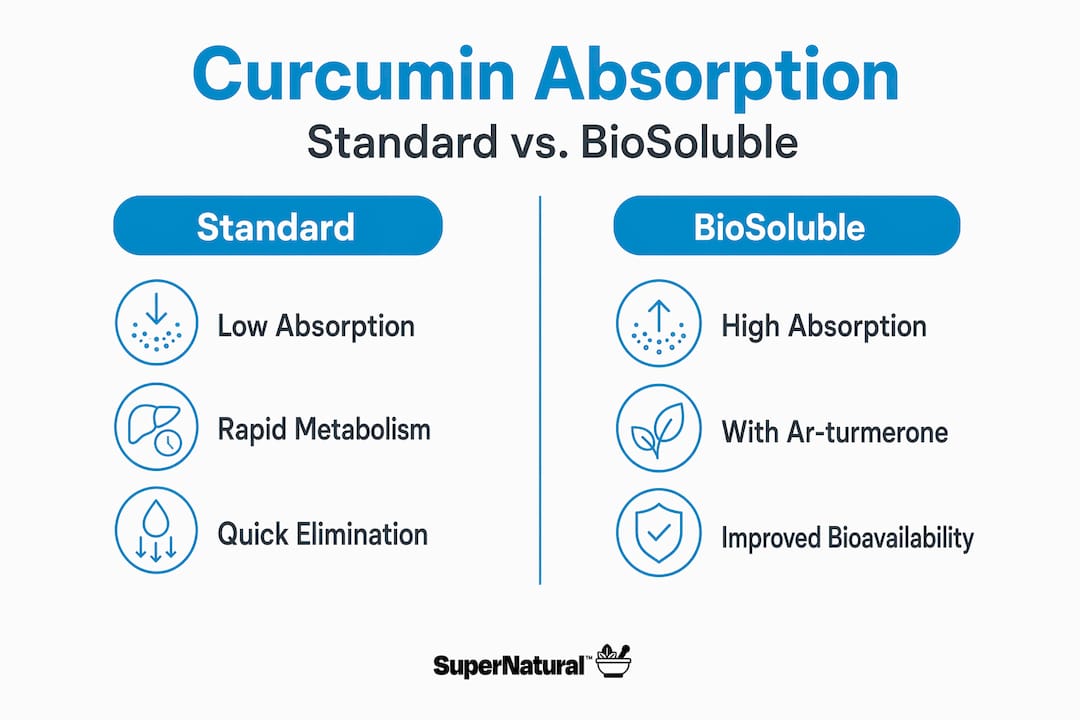
Standard curcumin has notoriously low bioavailability. It’s poorly absorbed, rapidly metabolized, and quickly eliminated. Many products try to address this using piperine (the active compound in black pepper), which does improve absorption to a degree, but can also interact with medications and cause digestive discomfort at higher doses.
BioTurm™ (the patented form behind SuperNatural’s BioSoluble Curcumin) takes a different approach. In a published clinical study, BioTurm™ achieved significantly higher systemic exposure than standard curcumin extract combined with 1% piperine, reaching up to 60x higher plasma concentration. That’s not a marketing number. It’s a pharmacokinetic finding from a randomized study.
The mechanism is part of what makes it genuinely interesting. BioSoluble Curcumin includes ar-turmerone, a naturally occurring compound from turmeric that works synergistically with curcuminoids to improve absorption without relying on synthetic bioavailability enhancers. It’s a formulation designed around the full complexity of the plant, not just an isolated extract with a synthetic booster added.
| Feature | Standard curcumin + piperine | BioSoluble Curcumin (BioTurm™) |
|---|---|---|
| Bioavailability enhancement | Modest (via piperine) | Up to 60x higher plasma concentration |
| Synthetic enhancers | Yes (piperine) | No synthetic additives |
| Drug interaction risk | Possible (piperine inhibits enzymes) | Reduced |
| Studied safety profile | Variable | Confirmed up to 1000mg/day |
| Mechanism | Passive absorption aid | Ar-turmerone synergy |
On safety: published research confirms that high doses of advanced turmeric formulations are well tolerated in healthy adults, with gastrointestinal tolerance confirmed through dedicated safety studies. That level of documentation is not standard in the supplement industry, and it matters.
Pro Tip: When evaluating any supplement’s bioavailability claims, look for published pharmacokinetic data with plasma concentration measurements, not just “enhanced absorption” language on a label. Real bioavailability data looks like the BioTurm™ study: comparative, measured, and peer-reviewed. For more on this topic, the overview of curcumin supplements benefits and bioavailability is worth your time.
Practical guide to choosing and using supplements responsibly
To bring these insights together, here’s a practical framework for choosing and using supplements effectively and safely. This isn’t a list of products. It’s a decision framework that works regardless of what you’re considering.
Step-by-step evaluation process:
- Identify your specific need. Supplements work best when filling a verified need, such as a documented deficiency or a health goal tied to a specific physiological gap, rather than serving as a general wellness hedge.
- Check for ingredient standardization. Look for supplements that specify exactly what percentage of active compound is present (e.g., “95% curcuminoids”) rather than listing only raw ingredient weight.
- Look for third-party testing. Certifications from NSF International, USP, or Informed Sport confirm that what’s on the label is actually in the product.
- Review the clinical evidence. Does the evidence come from human trials or only cell culture and animal studies? Human trials, especially randomized controlled trials, carry far more weight.
- Talk to your healthcare provider. This is especially important when you’re managing a health condition or taking prescription medications.
Beyond the evaluation checklist, a few additional cautions are worth keeping in mind:
- Avoid stacking multiple supplements without guidance. Complex topic: supplement interactions are real, and some combinations can interfere with medication absorption or produce unexpected effects.
- More is not always better. High doses of fat-soluble vitamins, iron, and certain herbs can cause toxicity over time.
- Supplements work within a health foundation. Diet, sleep, and regular movement determine how much any supplement can actually move the needle for you.
For a concrete roadmap on building habits that support brain health alongside smart supplementation, the step-by-step brain health habits guide covers what research consistently shows actually works. And if you want to revisit the fundamentals on safe supplement use practices, that resource applies across every category.
Why the supplement industry’s complexity requires informed skepticism
We’ve been in supplement science long enough to say this plainly: the industry has a confidence problem, and it’s not always the brands you’d expect.
The supplement space is frequently described as a “wild west” where marketing outpaces both the evidence and the regulation. That framing is accurate, but it misses something important. The problem isn’t just bad actors. It’s that the regulatory framework creates structural incentives for overselling. When you’re legally permitted to make broad structure/function claims without proving efficacy, why would any company invest in expensive clinical trials? The honest ones do. Many don’t.
Clinicians are increasingly vocal that supplement claims are too weak to support broad recommendations, and they worry that aggressive supplement marketing displaces legitimate care. We think that concern is valid. A person who believes a brain supplement is protecting their memory may feel less urgency about addressing sleep, stress, or vascular risk factors that actually drive cognitive decline.
That said, we believe blanket skepticism is as unhelpful as blind trust. Some supplements are backed by real pharmacokinetic data, real safety studies, and real clinical outcomes. The work is separating those from the noise, and that requires looking past the marketing and directly at the evidence. Every product worth your money should be able to show you its data, not just its claims.
You can explore a balanced view of what the evidence does and doesn’t support on supplement benefits and caveats. The goal isn’t cynicism. It’s clarity.
Explore BioSoluble® Curcumin™ and other advanced supplements
We put years of research into formulations that hold up when you actually look at the data. SuperNatural’s BioSoluble® Curcumin™ is built around BioTurm™, the patented form with documented 60x higher plasma concentration compared to standard curcumin with piperine. That’s the kind of bioavailability evidence we think every supplement should have to show.
If you’re focused on cognitive support, BrainBoost is formulated specifically for advanced focus using thoughtfully chosen, researched ingredients. For immune support and overall wellness, BodyBoost brings natural compounds together in a formula designed for real-world daily use. And if you want to start with the foundation, BioSoluble Curcumin is where the science behind our approach is most clearly on display. Every product comes with full transparency on what’s inside and why.
Frequently asked questions
Are all supplements labeled as ‘science-backed’ truly supported by solid research?
Not necessarily. The evidence base for many supplements is complicated by inconsistent dosing, varying compound forms, and regulatory frameworks that don’t require efficacy proof before a product reaches shelves.
Can supplements improve brain focus and prevent memory loss?
Current expert consensus is clear: no strong evidence supports the idea that supplements can meaningfully improve brain health or prevent memory loss, regardless of what the marketing language suggests.
What makes BioSoluble Curcumin different from regular turmeric supplements?
BioSoluble Curcumin uses the patented BioTurm™ formulation, which includes ar-turmerone to naturally enhance absorption. Published pharmacokinetic research shows BioTurm™ achieves significantly higher systemic exposure than standard curcumin with piperine, without relying on synthetic enhancers.