

Most people walk into a supplement aisle or browse an online store and pick based on the longest ingredient list or the most dramatic claims on the label. That approach, while understandable, is exactly backward. The research is clear: what drives real cognitive and anti-inflammatory outcomes isn’t the number of ingredients or the size of the dose. It’s the mechanism behind each ingredient, the quality of human trial evidence, and whether the formulation actually delivers the active compound to your bloodstream. This guide walks you through the smarter way to evaluate every bottle you consider.
Table of Contents
- Why supplement choice isn’t just about more ingredients
- How curcumin works for cognition and inflammation
- Formulation and bioavailability: What really counts
- Duration, dosing, and evidence: Making your choice count
- Our take: What most guides miss about supplement choices
- Ready to take action? Evidence-backed options to consider
- Frequently asked questions
Key Takeaways
| Point | Details |
|---|---|
| Evidence matters most | Choose supplements with mechanisms and human trial support, not marketing hype. |
| Bioavailability is critical | Formulation and absorption play a major role in cognitive and inflammation outcomes. |
| Duration over dose | Clinical benefits for cognition appear only with trial-aligned durations—not just high dosing. |
| Transparency beats blends | Products with clear PK and trial data outperform those relying on ingredient combinations. |
| Application drives results | Selecting your supplement based on evidence and practical trial checks gives the best chance for real benefit. |
Why supplement choice isn’t just about more ingredients
Walk into any health food store and you’ll see supplements promoting “10-in-1 blends” or “triple-strength formulas.” The assumption baked into this marketing is that quantity equals potency. It doesn’t. A product crammed with fifteen ingredients at subtherapeutic doses will rarely outperform a single, well-formulated compound backed by human clinical trials.
Real efficacy starts with mechanism. What does the ingredient actually do inside the body? For cognitive support, that means asking whether it crosses the blood-brain barrier, modulates neuroinflammation, or protects neurons from oxidative stress. For inflammation, it means asking whether it targets specific inflammatory pathways (like NF-kB or COX-2) rather than just producing a vague “anti-inflammatory effect.”
When evaluating any supplement, we recommend applying a three-part framework:
- Mechanism: Is the ingredient’s biological action clearly defined and relevant to your health goal?
- Human trial evidence: Has it been tested in peer-reviewed, randomized controlled trials in humans, not just in cells or animals?
- Formulation transparency: Does the label tell you the exact dose, delivery form, and ingredient source?
These aren’t complicated questions. But most consumers never ask them because marketing doesn’t encourage them to.
“Be skeptical when a supplement claims that more ingredients or higher doses always produce better results. Clinical trials on curcumin show that outcome depends far more on duration and formulation than on raw quantity.”
Exploring the range of natural ingredients for cognition reveals how specific and targeted a good formula should be. And as Harvard Health notes on supplement skepticism, many widely sold brain health products lack the human evidence needed to back their claims. The brain health supplements space is particularly vulnerable to this problem.
Pro Tip: Don’t trust claims of “more = better” unless dose-duration is proven in human trials. A shorter ingredient list with solid evidence behind each component beats a sprawling formula with none.
How curcumin works for cognition and inflammation
Curcumin is the primary active compound found in turmeric (Curcuma longa). It has been studied for decades, and the research picture is both promising and nuanced. Understanding both sides is essential before you invest in a curcumin product.

On the promising side, curcumin works through several well-defined mechanisms: it reduces oxidative stress by neutralizing free radicals, suppresses neuroinflammatory pathways (particularly NF-kB signaling), and modulates neuroprotective proteins like BDNF (brain-derived neurotrophic factor). Think of it like a multi-tool for cellular health. The challenge, though, is translating that cellular action into real clinical outcomes. As the research confirms, curcumin’s cognitive mechanisms are well-characterized, but clinical translation is significantly limited by formulation-dependent bioavailability.
Here’s a step-by-step picture of how curcumin moves from theory to practical outcome:
- Mechanism: Curcumin targets oxidative stress and neuroinflammatory pathways.
- Trial evidence: Human randomized controlled trials test its actual cognitive and anti-inflammatory effects.
- Formulation: The delivery form (standard powder, phytosome, water-dispersible micellar) determines how much actually absorbs into the bloodstream.
- Delivery to target tissue: Only absorbed (unconjugated) curcumin can cross into tissues and produce effects.
- Clinical outcome: Measurable improvements in cognition or inflammation markers that are statistically significant.
The evidence also shows an important nuance: curcumin improved cognition only in specific subgroups, particularly older adults who supplemented for 24 weeks or more. That’s a critical finding. It means curcumin isn’t a one-size-fits-all quick fix; it requires patience and the right product design.
“Curcumin’s clinical relevance depends almost entirely on formulation and trial duration. A well-designed product at the right dose, taken consistently over months, is what separates real benefit from wishful thinking.”
| Feature | Traditional curcumin | Enhanced formulation |
|---|---|---|
| Absorption rate | Very low (less than 1% bioavailable) | Significantly higher (up to 48X reported) |
| Duration of effect | Short plasma half-life | Extended plasma presence |
| Clinical outcome data | Limited, mixed results | Stronger when paired with trial-aligned dosing |
| Water dispersibility | No | Yes (e.g., micellar formulations) |
You can read more about curcumin health benefits, including how formulation shapes real-world outcomes. For a deeper look at clinical applications, the curcumin evidence and impact resource is worth reviewing. And if you want to understand the absorption science in plain language, curcumin absorption explained covers the key concepts clearly. Independent testing site ConsumerLab’s curcumin review also provides useful third-party analysis of products on the market.
Formulation and bioavailability: What really counts
Here’s where things get interesting and where most supplement marketing falls apart. Bioavailability refers to the proportion of a substance that actually enters circulation and has an active effect. For curcumin, standard powder formulations have notoriously poor bioavailability. Your body struggles to absorb it because it’s poorly water-soluble, rapidly metabolized, and quickly eliminated.
The supplement industry responded to this problem with a wave of enhanced delivery technologies: phytosomes (curcumin bound to phospholipids), nanoparticles, liposomes, and micellar formulations. These innovations genuinely improve absorption, but the marketing around them often overstates the effect or misrepresents what’s being measured.
The critical metric is unconjugated curcumin in plasma. This is the biologically active form. Some products inflate their bioavailability claims by measuring total curcumin metabolites (including conjugated forms that may be inactive) rather than the free, unconjugated compound. According to peer-reviewed pharmacokinetic research, bioavailability claims need validation through plasma unconjugated curcumin levels, and even enhanced formulations show limited absolute absorption.
| Formulation type | Relative bioavailability claim | Key measurement concern |
|---|---|---|
| Standard curcumin powder | Baseline (1X) | Very low plasma levels |
| Piperine-enhanced | 20X improvement | Still conjugated-form dominated |
| Phytosome (e.g., Meriva) | 20-29X improvement | Some unconjugated curcumin data |
| Micellar/water-dispersible (e.g., BioSOLVE) | Up to 48X higher bioavailability | Water-dispersible, strong absorption profile |
| Liposomal | Variable | Limited rigorous human PK data |
Products using BioSOLVE Curcumin technology stand out because they offer genuine water-dispersibility, which addresses one of curcumin’s fundamental absorption barriers. However, we always encourage you to ask for the actual human pharmacokinetic (PK) data, not just the marketing number.
Watch out for these common pitfalls in bioavailability claims:
- Total vs. unconjugated curcumin: Marketing may measure total metabolites, not the active form.
- Short-term plasma spikes: A brief peak in plasma levels doesn’t mean sustained tissue delivery.
- Added ingredients with no proven effect: Some formulas add piperine or other compounds that change absorption data without corresponding clinical outcome improvements.
- No published human PK data: If the company can’t point you to a peer-reviewed pharmacokinetic study, treat the claim with appropriate skepticism.
Pro Tip: When a product claims “48X better absorption,” ask one follow-up question: “Compared to what, measured how, and in what human study?” That one question filters out most misleading claims instantly.
For practical guidance on selecting bioavailable products, the bioavailable supplement guide breaks down the key criteria clearly. You can also explore how formulation affects curcumin benefits for inflammation, and why bioavailability matters in your overall supplement strategy. For a broad overview of evidence and applications, curcumin best uses provides a solid foundation.
Duration, dosing, and evidence: Making your choice count
You’ve done the research on mechanism and formulation. Now you need to map your supplement strategy to what clinical trials actually showed. This is the step most people skip, and it’s where real outcomes diverge from supplement marketing promises.
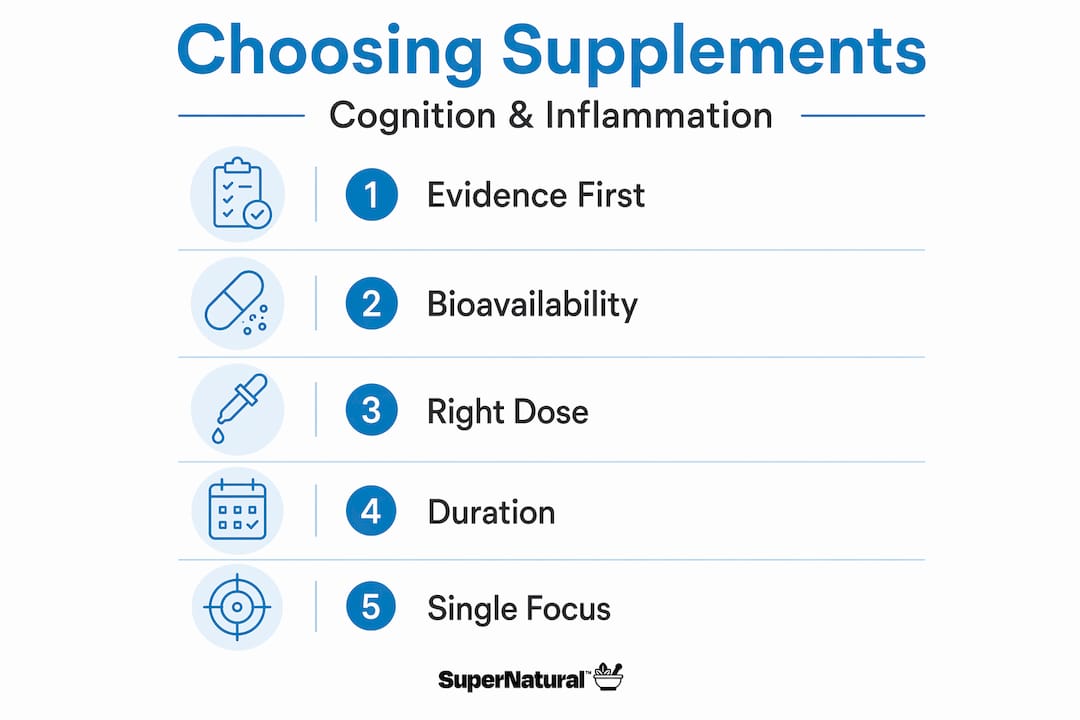
Here is a practical five-step process for choosing a supplement that aligns with real evidence:
- Define your goal clearly. Are you targeting cognitive performance, reducing systemic inflammation, or both? Different goals may need different product priorities.
- Identify the right mechanism. Match the ingredient’s known action to your goal. Curcumin’s neuroprotective and anti-inflammatory pathways are well-characterized and relevant to both.
- Check the dosing against trial data. Most positive curcumin trials used daily doses between 500mg and 2,000mg. If a product uses a proprietary blend that doesn’t disclose individual amounts, that’s a red flag.
- Benchmark against trial conditions. If the trials that showed benefit lasted 24 weeks, plan your supplementation accordingly. Short-term use, regardless of dose, is unlikely to replicate those results.
- Verify the formulation delivers what’s on the label. Look for third-party testing, certificates of analysis, and published human PK data that confirm what you’re actually getting.
Key statistic: Curcumin’s cognitive benefits were statistically significant only when trials lasted 24 weeks or more. Duration, not just dose, is the deciding variable.
Why do so many products fall short of this standard? Because the supplement industry is not required to prove efficacy before going to market. This means products can be formulated to look impressive on a label without ever being tested at clinically relevant doses or durations.
Common ways product claims miss the trial-relevant mark:
- Providing a lower total daily dose than what was tested in successful trials.
- Using shorter “starter” protocols (4 to 8 weeks) that don’t match the 24-week threshold where evidence becomes meaningful.
- Failing to disclose the specific curcuminoid content per serving, making it impossible to compare to trial dosing.
- Combining curcumin with many other ingredients at sub-dose levels, diluting the per-ingredient effect.
As Harvard Health cautions directly, many brain health supplement ingredients have not demonstrated clear improvements in thinking or memory in rigorous trials. That’s not an argument against supplementation. It’s an argument for being selective and evidence-guided.
Building practical brain health habits alongside a well-chosen supplement strategy is the most effective approach overall.
Our take: What most guides miss about supplement choices
We’ve spent years reviewing the clinical literature, working with formulation scientists, and listening to what our customers actually experience. The honest conclusion we’ve reached is this: the supplement industry has a transparency problem, and it’s not getting better on its own.
Most “brain health” or “anti-inflammatory” products are built around ingredients that test well in marketing focus groups, not in human clinical trials. Proprietary blends that hide individual doses, vague claims about “supporting” cognitive function, and bioavailability percentages with no published backing are all symptoms of the same problem: the product was designed to sell, not to perform.
Real progress, in our experience, comes from three things: ingredients backed by published human pharmacokinetic data, formulations designed around those findings, and honest label transparency about what you’re getting in every dose. It’s not complicated. It’s just not how most supplement companies operate.
“If it’s not in published human PK or trial data, it doesn’t belong in your supplement strategy. Full stop.”
We’ve seen customers switch from multi-ingredient proprietary blends to a single, well-formulated curcumin supplement and report meaningful differences within the first few months. Not because curcumin is magic, but because for the first time they were actually absorbing a therapeutic amount of the active compound consistently over a meaningful duration.
Pro Tip: Ignore product combinations unless each ingredient in the blend has standalone human trial support at the dose listed. Single, well-tested ingredients taken consistently and at the right formulation almost always outperform a flashy 12-ingredient blend with no cohesive clinical rationale.
The supplement industry will keep releasing impressive-sounding products. Your job, as an informed consumer, is to ask the right questions every time.
Ready to take action? Evidence-backed options to consider
Understanding the science is the first step. Taking action with the right product is the next one. We built SuperNatural supplements around exactly the evidence-based principles covered in this guide, starting with our foundational technology.
Our BioSoluble Curcumin technology uses a patented water-dispersible process that dramatically improves bioavailability over standard curcumin, addressing the core absorption barrier head-on. For targeted cognitive support, our BrainBoost supplement is formulated specifically for advanced cognitive performance, built around the clinical evidence for curcuminoid delivery and neuroprotective support. Every product in our lineup is designed with formulation transparency and trial-aligned dosing in mind. Explore the full range at SuperNatural supplements and find the option that matches your health goals and the evidence behind them.
Frequently asked questions
How long should I take curcumin for cognitive benefits?
Trial evidence confirms that curcumin needs to be taken for at least 24 weeks to produce statistically significant cognitive benefits. Shorter supplementation periods have not demonstrated the same outcomes.
Do water-dispersible or “high bioavailability” curcumin products really work better?
Enhanced formulations do improve absorption compared to standard powder, but unconjugated curcumin levels remain relatively low even with advanced delivery systems. Clinical benefit still depends on consistent use at trial-relevant doses over adequate duration.
Can supplements really improve memory or prevent brain aging?
No supplement is proven to prevent memory loss or reliably improve thinking in all adults, but select well-formulated products may provide meaningful support for specific groups, particularly older adults using evidence-aligned protocols.
Is dosing or duration more important for supplement effectiveness?
Both matter, but clinical trial outcomes for curcumin show that duration is the stronger predictor of cognitive benefit. Taking a high dose for a short period is less likely to replicate the results seen in successful long-term trials.
How should I evaluate supplement marketing claims?
Demand published human pharmacokinetic and trial data before trusting any claim. Trial transparency including dose, duration, and outcome measures is the minimum standard. Marketing language without peer-reviewed backing should always raise a flag.